Season 4 · Episode 1
Vietnam
One country, two worlds, and thousands of stories between them.
On this page ▾
By Sorin Mihailovici · Travel by Dart · Last updated August 2026 · ~17 min read
Most Travel by Dart episodes begin with me not knowing where I'm going. This one was different: Vietnam was near the top of the very short list of places I'd always hoped the dart would find, and when it finally did, I decided not to keep it to myself. I put a call out on my social channels — anyone who wanted to come spend a week travelling with me could apply — and within 24 hours my inbox was full. That's the Spark Experience: a rotating crew of strangers-turned-friends who join me on the road. Nine of them flew to Hanoi from all over the world, some I knew, most I didn't, and together we set out to see whether Vietnam could possibly live up to the version in my head. It didn't. It beat it.
Quick facts: Vietnam at a glance
- Population
- Nearly 100 million
- Capital
- Hanoi (north); largest city Ho Chi Minh City / Saigon (south)
- Language
- Vietnamese (a tonal language)
- Currency
- Vietnamese đồng
- Divided
- North & South, 1954–1975; reunified 1976
- Star sights
- Halong Bay, Cu Chi Tunnels, Sapa, Hoi An
- Shape
- Long and narrow — 1,650 km north to south
- Known for
- Pho, motorbikes, war history, karst landscapes
One Country, Two Worlds
The first thing to understand about Vietnam is that it is really two places wearing one name. A country of nearly 100 million people, it was split into North and South — two separate states — from 1954 until the war ended in 1975, and formally reunified in 1976. That's only fifty years ago, within living memory, and you can still feel the seam. The north, centred on Hanoi, is older, slower, more traditional, more shaped by a thousand years of history. The south, centred on Saigon, is faster, brasher, more commercial — the Vietnam of neon and global brands. Travelling the length of the country, as we did, is really travelling between two temperaments that happen to share a flag — stretched along a coastline that runs some 1,650 kilometres north to south, so narrow in the middle you can cross it in a day.
Even the writing sets Vietnam apart from its neighbours. Vietnamese is written in the Latin alphabet — a system called quốc ngữ, developed by European missionaries in the 17th century and later adopted nationwide — which is why, as a Westerner, you can at least read the street signs and menus here, even if the tones guarantee you'll mangle them out loud.
It's also a country defined, for outsiders, by a war — and one of the quiet lessons of this trip was how ready Vietnam is to be known for something else. Several of my crew had complicated feelings coming in; one was old enough to remember the draft, another was part-Vietnamese, born in Thailand and raised in Laos, wondering if he might literally pass a cousin on the street. What we all found was a nation that has, remarkably, moved on. Former American soldiers now return here to retire. Fifty years after the guns went silent, Vietnam would rather show you its food, its landscapes and its relentless, cheerful creativity — and so that's mostly what this story is about.
Hanoi: Organized Chaos
Hanoi hits all your senses at once. It reminded me of India — the same beautiful overwhelm — but with the ocean and the rivers in the air, the humidity, the frying fragrances, the sheer density of life. Locals call it "organized chaos," and that's exactly right: it looks like anarchy and runs like clockwork. In one district our guide told me the population density hits 33,000 people per square kilometre, and you feel every one of them.
My first act as host was to gather everyone for a welcome dinner at Madame Hien, a restaurant named for a real and much-admired Vietnamese woman who opened it late in her life; over the years it grew famous enough to serve visiting political figures and heads of state. Breaking bread there on the first night — strangers from four continents slowly becoming a crew — was the moment the trip actually began.
The best way I found into the real city was a man named Tommy, who runs Hanoi Backstreet Tours in refurbished Russian army jeeps — the actual Soviet vehicles, many built around 1973, that Russia once shipped in to support the North during the war, later sold off to collectors and guides. (There are no seatbelts. That's part of the deal.) Tommy is one of the most creative people I've ever met, and his house proves it. Everything in it is reborn from something else: a table made from a tractor, an aquarium built into a car tyre, benches welded from old bike parts, a decades-old Minsk motorcycle mounted on the wall as art. When Vietnam was poor, he explained, you recycled everything — and that habit hardened into a whole aesthetic. "Reincarnation," he called it.
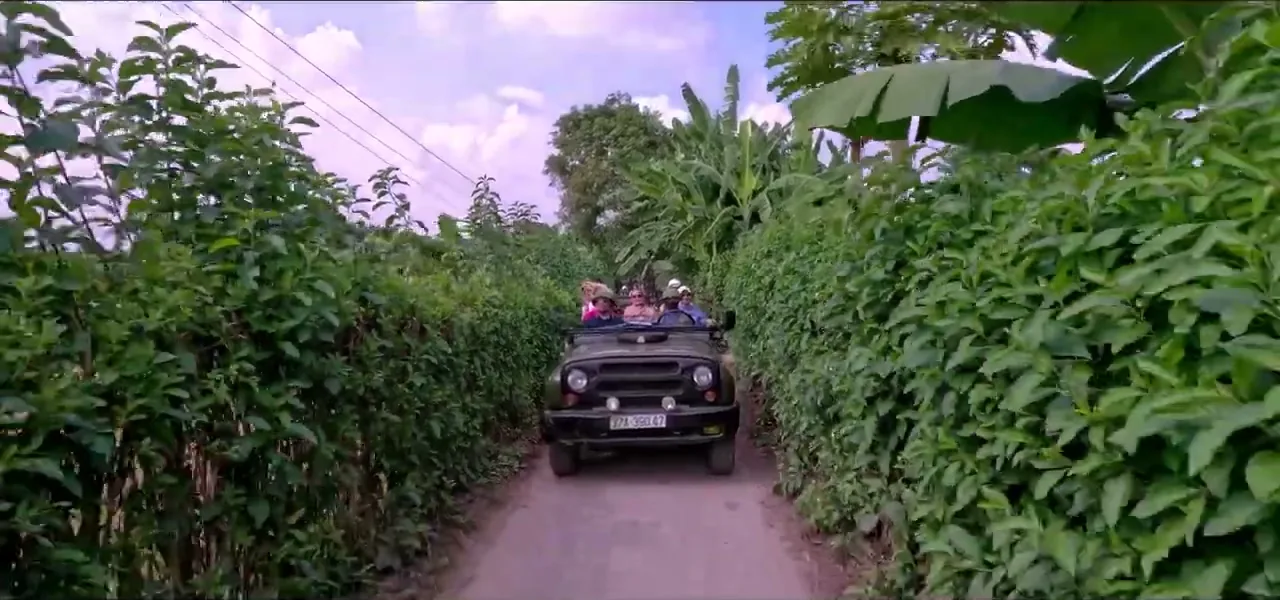
The jeeps took us where package tourists rarely go. We visited a "secret village" of people living without identity cards — and without papers, it's desperately hard to enrol in school, see a doctor, or get a proper job in the city; there's no grid electricity, so solar panels sit on the roofs. We threaded through back alleys so narrow the daylight barely reaches the ground, walls plastered with hand-painted phone numbers — Vietnam's version of free advertising: need your toilet fixed, call the number on the wall. It's an intimate, unvarnished portrait of how a huge city actually lives, and it stayed with me longer than any monument.
The Train That Runs Through the Living Room
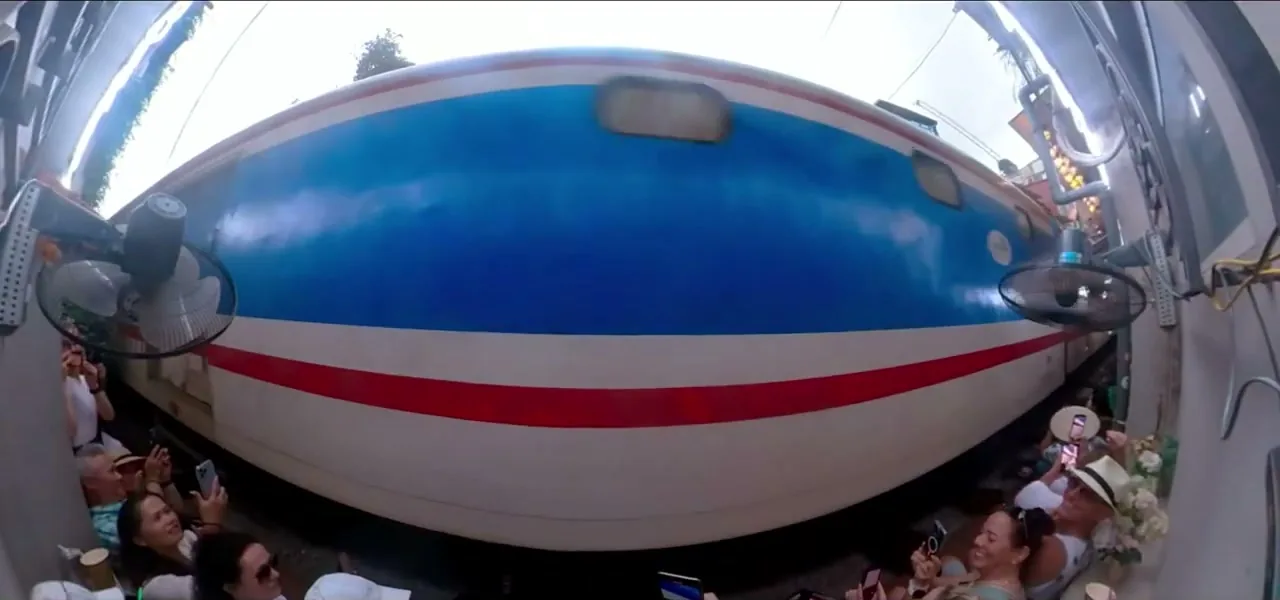
Of everything Tommy promised, one thing had me giddy as a seven-year-old: Hanoi Train Street. Generations ago, people built their homes right up against the railway line to sell to passing travellers, and the city grew in around the tracks until, today, a working train squeezes down what is essentially a residential street — passing inches from front doors, café tables, and anyone standing in the wrong place. We did what kids everywhere do: laid coins and bottle caps on the rails to be flattened, and waited.
When the train came through, it was genuinely intense — close enough that a careless arm could be broken, close enough to feel the wind and the weight of it. Everyone presses back against the walls, the train thunders past a hand's width away, and then it's gone and the street exhales and turns back into a street. It is one of the most iconic, slightly insane travel experiences I've had — and yes, we retrieved our beautifully squished coins.
Vietnamese food, for the adventurous, goes well beyond pho. I tried snails, scooped from their shells with a stick and dipped in a lime-and-chilli sauce — genuinely good — and then sparrows, tiny grilled birds you squeeze with lime, dip in salt, and eat more or less whole. My honest review of the sparrow was "salty rubber," but that's the whole point of travelling this way: you eat what the place eats, and you find out.
Halong Bay: The Descending Dragon
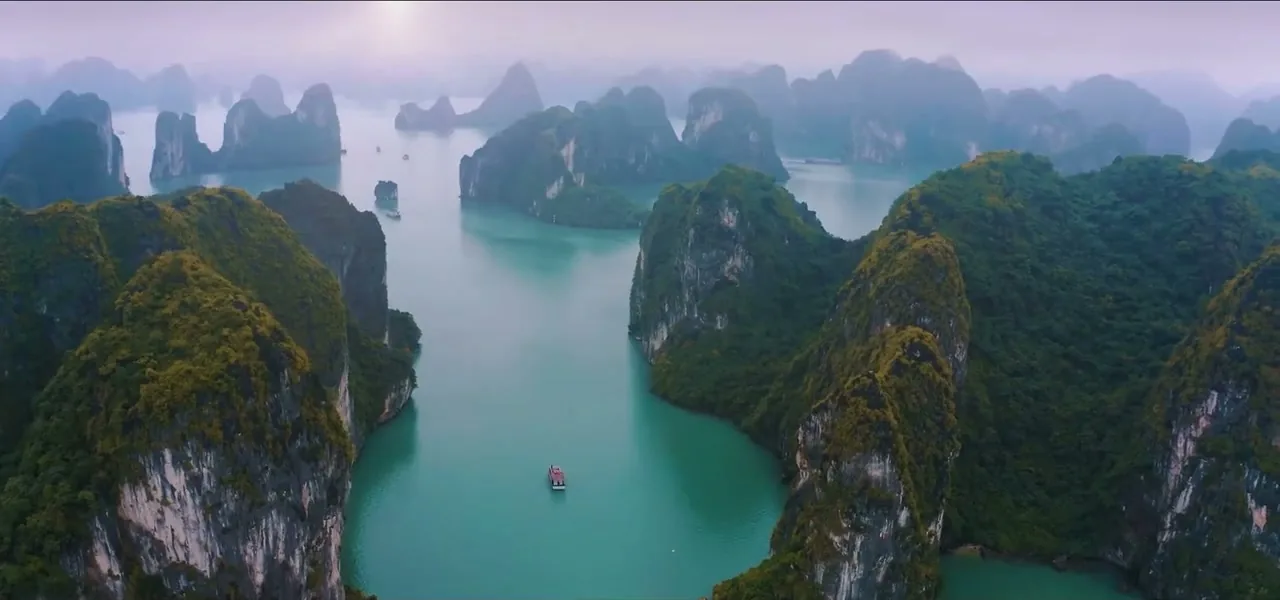
Then came the one I'd waited years for. Halong Bay is a UNESCO World Heritage Site and one of the New 7 Wonders of Nature, a labyrinth of roughly 1,600 limestone karst islands rising sheer out of emerald water. Its name means "descending dragon," and the legend is lovely: a great dragon and her children came down from heaven to defend the Vietnamese, spitting out jewels and fire that hardened into the thousands of islands you see today. My whole crew's jaws dropped the moment we boarded our overnight cruise — Mike, Teresa, Christine, all of them — and I don't blame them.
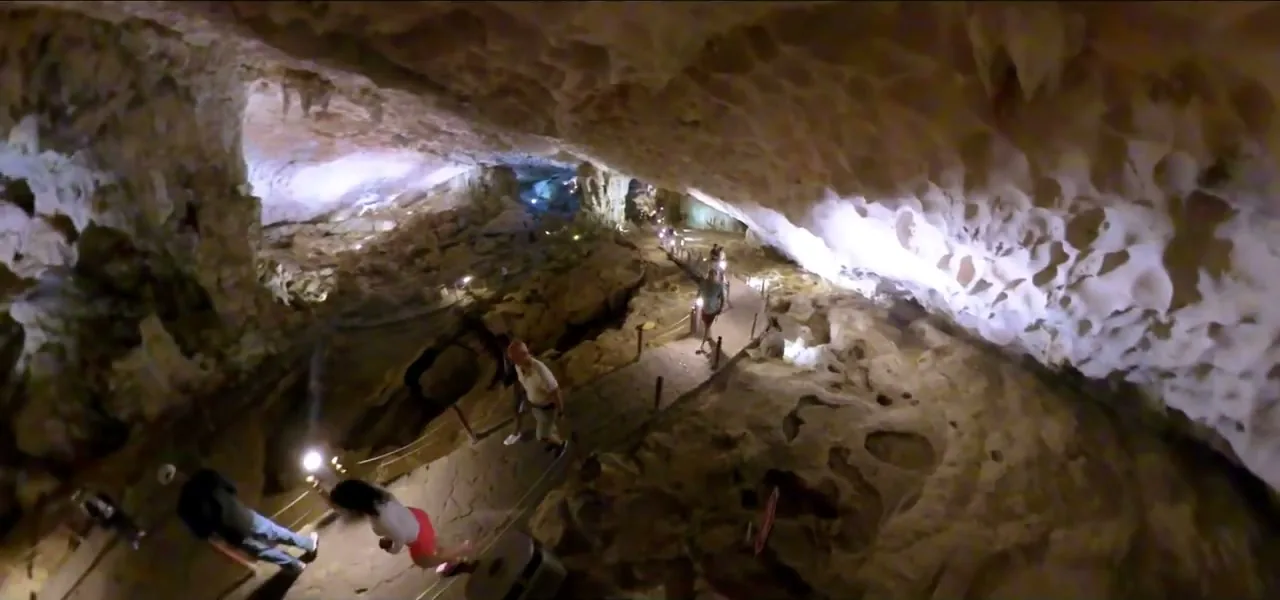
The bay is riddled with caves — most of Halong is limestone, endlessly dissolved and sculpted by water — and the grandest is Sung Sot, the "Surprise Cave," a cathedral of stone you climb hundreds of steps to explore. We hiked the 400-odd steps up Ti Top Island for the postcard panorama of islands scattered to the horizon; we kayaked through a low sea-cave into a hidden lagoon where monkeys came down to the water to investigate the boats; and at night we anchored among the karsts, ate well, and — inevitably — sang karaoke until it became the trip's great bonding ritual. A few of the crew even rolled out of bed for 6 a.m. Tai Chi on the deck. (I, regrettably, did not. I was the only one who slept in, and I've never been prouder of a group for shaming me.) Waking up, opening the cabin window, and finding that seascape floating outside is a feeling I won't forget.
Halong Bay
Part Two: Tunnels, Rivers and Mountains
Halfway through, Vietnam was already climbing my all-time list — and the second half took it somewhere deeper: underground into the war, out onto the great river, and up into the mountains.
▶ Vietnam — Tunnels, Floating Villages & Mountain Tribes
Part two: Saigon, the Cu Chi tunnels, the Mekong Delta, Tam Coc, Sapa, Hoi An and the dart throw
Saigon and the Name That Still Stings
Flying south to Ho Chi Minh City, I thought I'd taken the wrong plane. Where Hanoi is old and dense, Saigon is modern — glass towers, global brands, energy — yet still layered with history. Almost everyone here still calls it Saigon, and there's a reason that runs deeper than habit. The city was renamed after the war, and for the older generation the official name carries the memory of a very hard time: when the North took the South, many southerners who had sided with the Americans lost their homes, their money, everything. To say "Saigon" is, quietly, to remember the city as it was. It's a small thing that tells you how close the past still is.
And yet the overwhelming feeling of Saigon today is not grief but motion. This is a city of motorbikes — millions of them, flowing through the intersections in a continuous, honking river that somehow never quite crashes. Crossing the street is a leap of faith: you step out at a steady pace, don't stop, don't flinch, and let the traffic braid itself around you. It shouldn't work. It always does. That, in miniature, is the whole city — chaotic, fast, and quietly, brilliantly organized.
Into the Cu Chi Tunnels
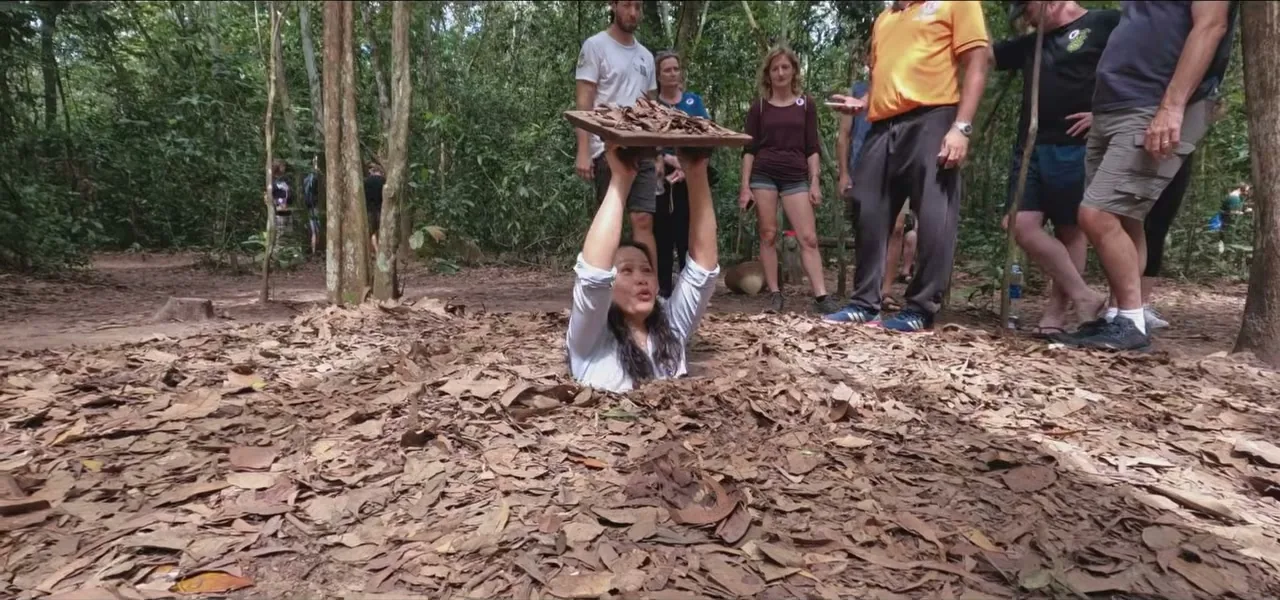
Nothing brought that closer than the Cu Chi Tunnels. This is one of the largest tunnel networks on Earth — around 250 kilometres of hand-dug passages on three levels — begun in 1948 against the French and expanded over roughly twenty years into a subterranean world of hiding places, supply routes, hospitals and living quarters used against the Americans. You can crawl through a preserved section, and I did: hunched, then on my knees, sweating, through a black squeeze of earth barely wide enough for a body. It's claustrophobic and humbling in equal measure.
The Mekong and the Foot-Rowers of Tam Coc
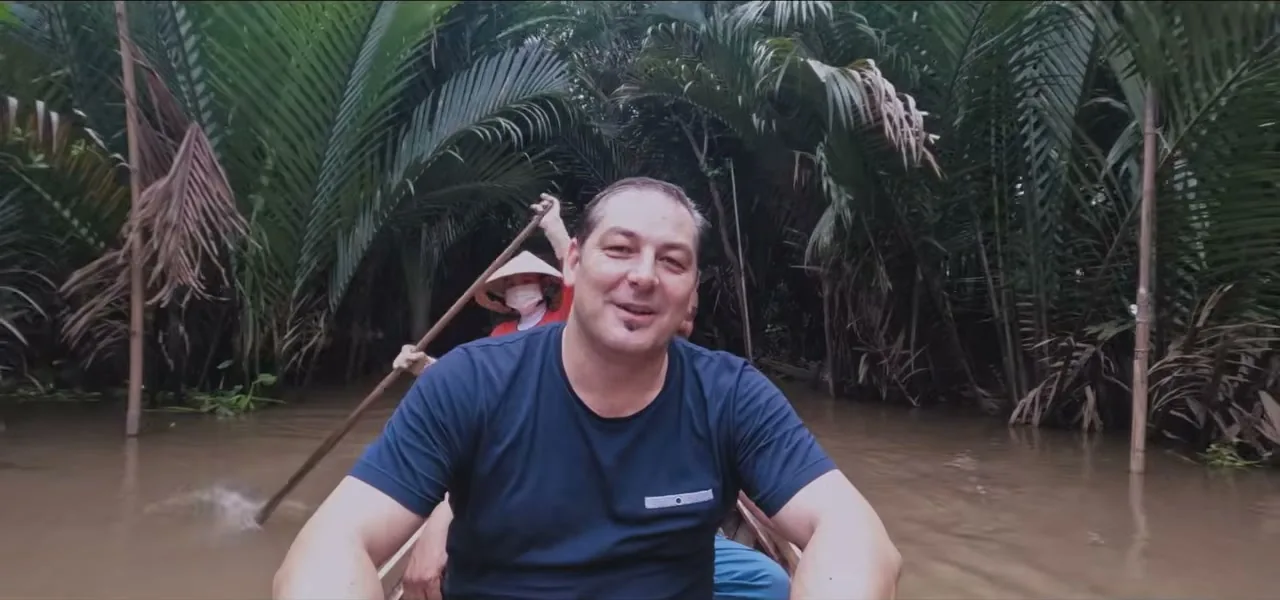
From the war we went to the water. The Mekong is the longest river in Southeast Asia — around 4,350 kilometres, rising on the Tibetan Plateau and running through six countries before it fans out into Vietnam's delta. For one of my crew the river was personal: his family had escaped Laos by crossing the Mekong into Thailand years earlier, and the word alone brings it all back for him. We poled through the delta's narrow channels in little boats, ended up in a village with a very large pet snake, and — because you should try everything once — drank snake wine, a rice liquor with a whole snake steeping inside, long believed to be a tonic for longevity. It was, against all odds, sweet. "Snakealicious," I believe I said.
Further north, in the karst country of Ninh Binh — often called "Halong Bay on land" — I met the most extraordinary rowers in Vietnam. In Tam Coc, the boatmen and boatwomen row with their feet, reclining back and working the oars with their legs so their hands stay free. It looks effortless and is anything but; when I tried, I couldn't move the boat an inch. "The longest three minutes of my life," I called it — and a local diplomatically decided my legs were simply too long. Above the valley rises Mua Cave, where 500 stone steps climb to a mountaintop pagoda and a carved dragon — the dragon being the holy creature Vietnamese tradition credits with bringing rain to the rice. The steps nearly finished me; the view of green fields threading between limestone towers made every one of them worth it.
Sapa: A Different Way to Live
When the Spark Experience ended and my friends flew home, I wasn't ready to leave — so I went on alone, up into the far northern mountains to Sapa, one of the great trekking regions of the world. With a local guide named Sung, I walked roughly ten kilometres through fog and terraced rice fields, village to village — Y Linh Ho, Lao Chai, Ta Van — and stayed overnight in a homestay with a family whose warmth needed no shared language (they're Giáy people; Sung is Black Thai; between us we juggled three tongues and a lot of laughing).
Sapa taught me things travel brochures never mention. Sung explained the local inheritance custom: a son inherits the family house and rice fields and, in return, cares for his parents into old age; a daughter inherits nothing from her own parents, but gains a share through the family she marries into. It's a whole social logic built around the land, matter-of-fact and unsentimental.
The homestay itself was the heart of it. After hours on a bus and hours more on foot, arriving in a simple mountain house, being fed by strangers and folded into their evening, is the kind of hospitality that reorders your priorities. We had almost no words in common — the family are Giáy, my guide is Black Thai, and Vietnamese was our fragile bridge — and it didn't matter in the slightest. You learn quickly that warmth doesn't require a shared language, only a shared table.
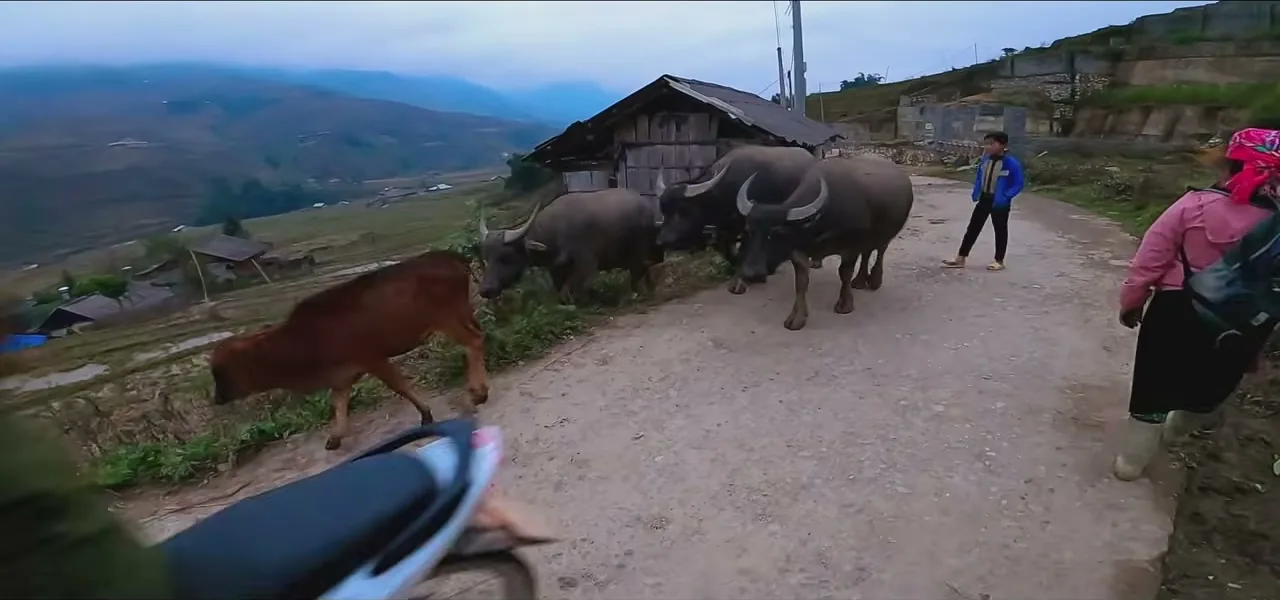
Travel — but don't only travel to rich countries. Travel to poor ones, so you can learn. Seeing how people live here, with so little and so much grace, changes how you see your own world. That, for me, was the whole point of Sapa.
Hoi An and the Basket Boats
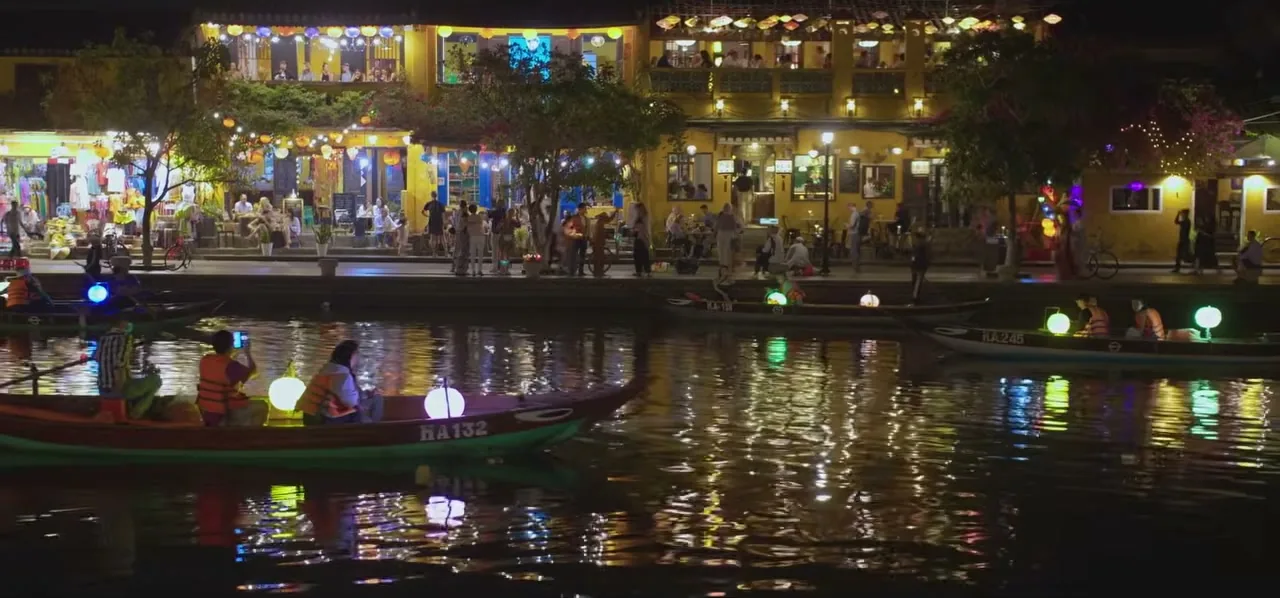
My last stop was Hoi An, an achingly pretty ancient town of coloured lanterns, wooden merchant houses and boat rides on a lantern-lit river — my own private "Venice of Vietnam." (My hotel bed was, bewilderingly, wider than it was long; I slept sideways and made peace with it.) Out in the water-coconut groves nearby I climbed into a thúng chai — a round bamboo basket boat — which comes with a wonderful origin story: under French colonial rule, boats were taxed, so resourceful locals built these circular ones and insisted, straight-faced, that they weren't boats at all but baskets. Tax dodged, tradition born. Spinning around in one is a joyful, slightly dizzying way to end a journey through Vietnam.
Where the Dart Points Next
This being Travel by Dart, it all ended with a throw — two, in fact. First I handed the map to my nine friends and let them decide their own group adventure: one by one, blindfolded, they threw, knocking out places I'd already been until it came down to a final between Seychelles and South Africa. A tie-break settled it, and the Spark crew earned themselves a trip to South Africa.
Then it was my turn, for the destination that would open the next episode. I threw blindfolded — using a Vietnamese-style world map with the Americas on the right and Asia on the left, just to keep myself honest — and the dart landed on Mongolia, the land of Genghis Khan. I knew almost nothing about it, and I'll admit I wasn't sure whether to be excited or nervous. But that uncertainty is the entire promise of this show: I don't get to choose, so I get to discover.
By the numbers: Vietnam by the numbers
- Population
- Nearly 100 million people
- North & South divided
- 1954–1975 (reunified 1976)
- Halong Bay islands
- ~1,600 limestone karsts
- Cu Chi tunnels
- ~250 km, three levels
- Mekong River
- ~4,350 km through 6 countries
- Mua Cave steps (Ninh Binh)
- 500 to the summit dragon
The Country That Earned Its Place
I don't say this lightly, because the dart has shown me a lot of the planet: Vietnam went straight onto my list of the top three countries I've ever visited. It has everything — one of the natural wonders of the world in Halong Bay, food you'll argue about for years, a history that will break your heart in a Cu Chi tunnel and then a mountain village that quietly rebuilds it, and, above all, people who are hardworking, funny, endlessly inventive, and generous to a stranger with a camera and nine friends in tow.
There's a symmetry to it that I only noticed later. This is a country that spent much of the last century being fought over and torn in two, and everywhere I went I found the opposite of bitterness: recycled jeeps reborn as tour buses, tunnels turned into places of remembrance, a tax dodge turned into a beloved basket boat, poverty turned into a genius for making do. Vietnam takes what it's handed and makes something better out of it — and that spirit, more than any single sight, is what stayed with me.
Come here for Halong Bay and the war history, by all means — but stay for the train street and the foot-rowers and the homestay in the fog, because that's where Vietnam actually lives. It gave me the best kind of travel there is: the kind that rearranges you a little. Watch both parts above, and if you want to see where the dart threw me next, the road led straight up onto the steppe of Mongolia.
Explore More Travel by Dart Journeys
- See where the dart threw me next: up onto the steppe of Mongolia.
- More of Southeast Asia the dart uncovered: Cambodia and Thailand.
- Island Southeast Asia in my Indonesia episode.
- Another Spark Experience with a crew of fans: the two-part Brazil adventure.
Suggested Sources & Further Reading
To go deeper into Vietnam, these are some of the best authoritative resources:
- Vietnam National Tourism (vietnam.travel) — the country's official tourism site.
- UNESCO — Ha Long Bay — the World Heritage listing for the limestone bay.
- Encyclopædia Britannica — Vietnam — history, geography and culture.
- Encyclopædia Britannica — Vietnam War — the war behind the Cu Chi tunnels.
All facts verified September 2026.
Vietnam: traveler questions
Is Vietnam safe for travelers?+
Yes — Vietnam is one of the safer countries in Southeast Asia for visitors, with very low rates of violent crime. The everyday hazards are practical ones: chaotic motorbike traffic (crossing the street in Hanoi is an art form), petty theft in tourist crowds, and the heat and humidity. Use normal common sense and a trusted local guide and you'll be fine. I travelled the length of the country, north to south, and never felt in danger.
What is the best time to visit Vietnam?+
Vietnam is long and narrow, so the climate varies hugely north to south. Broadly, spring (March–April) and autumn (September–November) are the sweet spots nationwide. The north (Hanoi, Halong Bay, Sapa) is best in autumn and spring; the far south (Ho Chi Minh City, the Mekong) is warm year-round with a dry season roughly December–April. Sapa's rice terraces are greenest before the September harvest.
Was Vietnam one country or two?+
Both, at different times. Vietnam was divided into North and South from 1954 until the end of the war in 1975, and formally reunified as one country in 1976. Fifty years on, you can still feel the differences: Hanoi in the north is older and more traditional, while Ho Chi Minh City (Saigon) in the south is faster, more modern and more commercial.
Are the Cu Chi Tunnels worth visiting?+
Absolutely — they're one of the most sobering and memorable things to do near Ho Chi Minh City. The Cu Chi tunnels are a vast underground network, around 250 km in total across several levels, dug by guerrilla fighters over decades against the French and then the Americans. You can crawl through a section (claustrophobic and unforgettable) and come away with a real appreciation for what the war meant on the ground.
What is Halong Bay and why is it famous?+
Halong Bay is a UNESCO World Heritage Site and one of the New 7 Wonders of Nature — a seascape of roughly 1,600 limestone karst islands and islets rising out of emerald water in northern Vietnam. Its name means 'descending dragon.' Most visitors experience it on an overnight cruise, exploring caves, kayaking, and waking up anchored among the towering rock formations.