Season 6 · Episode 6
Bali
An elephant took me to dinner — then the ride became illegal.
On this page ▾
By Sorin Mihailovici · Travel by Dart · Last updated November 2026 · ~16 min read
An elephant knocked, more or less, on my door, curled her trunk toward me, and took me to dinner. That is a sentence I never expected to write, and it is exactly how my time in Bali began. The next morning I scrubbed her down like a small grey mountain; that afternoon a different elephant dipped her trunk in paint and decorated my shirt; somewhere in between, one of them pulled me gently against her side in a gesture the keepers insist is affection, and I have decided to believe them.
Then came the complication. Not long after I left Bali, Indonesia became the first country in Asia to ban elephant riding. When I filmed, the ride was still legal — so you'll see it, and I'm not going to pretend it away. But the ban left behind a question that is far harder than the hashtags: the rides are over, the elephants are still here, and they are not going anywhere. So who pays to feed them now? I didn't come to Bali to tell you what to think. I came to show you what I saw.
How a Dart Led Me to Mason Elephant Park
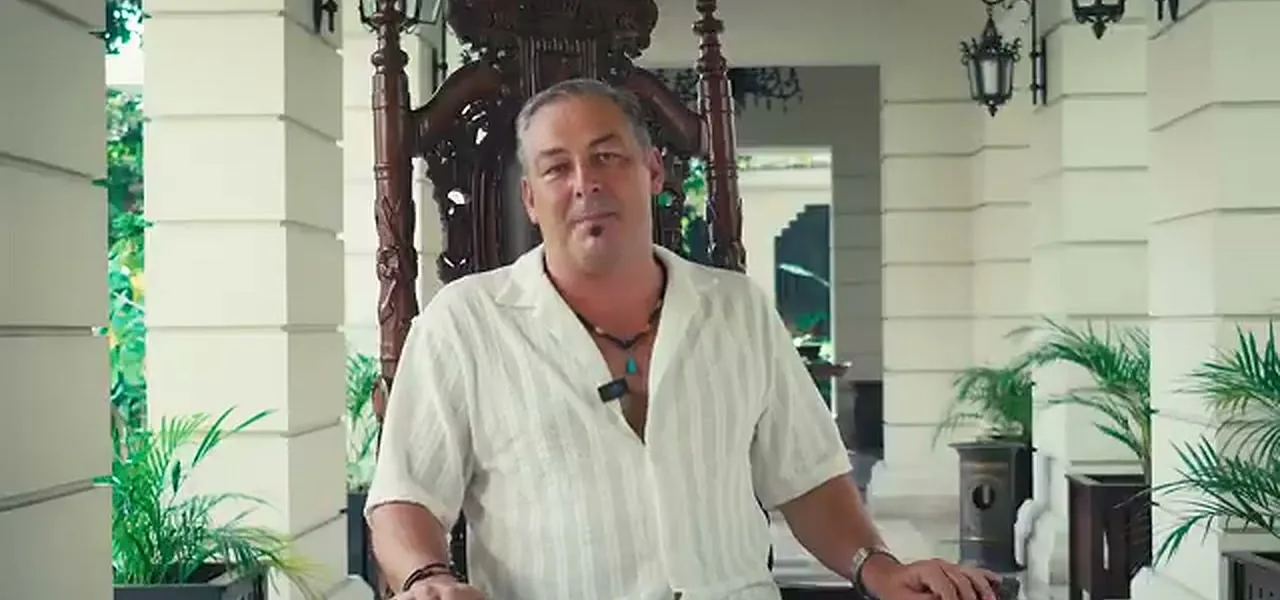
The dart that sent me across the planet was thrown blindfolded back in Puerto Rico; it hit Indonesia, and I'd already spent a rich week on Java before crossing to Bali, the country's Hindu island of temples, rice terraces and daily ceremony. In Bali I always try to find the people who live inside a place, and that's how I found Mason Adventures. Its founder, Nigel Mason, and his son Jian embraced what Travel by Dart does so warmly that they said: come stay at our elephant lodge.
What I learned about Nigel before I even arrived set the tone for everything after. During the pandemic, when tourism evaporated, he refused to shut the park down. The story goes that he sold his house in Australia and poured the money into the lodge so the animals, the staff and the local workers could keep going as if nothing had changed. Nigel himself couldn't be there during my visit — he was in Singapore for a medical situation, and Jian was in Japan — so I was handed to Ketut, who became my guide into a place that turned out to be far more than a park.
It's worth saying what makes Bali itself so different from the island I'd just left. In a country that is the largest Muslim-majority nation on earth, Bali is overwhelmingly Hindu — its own strain of it, Balinese Hinduism, woven through daily life in a way that's impossible to miss. You see it in the little palm-leaf offerings, the canang sari, laid on doorsteps and dashboards every morning; in the split stone gateways; in the carved temples that seem to stand on every corner and cliff. Ubud, the town I was based near, is the island's cultural and spiritual heart — a place of rice terraces, wood carvers, painters and healers set in the green hills of the interior, away from the southern beaches most people picture when they hear the word "Bali." It's the perfect base for exactly the kind of trip the dart had in mind.
Quick facts: Bali at a glance
- This trip
- Ubud & central Bali
- Where I stayed
- Mason Elephant Park & Lodge, Taro
- Bali's religion
- Hindu — Indonesia's Hindu island
- The elephants
- Sumatran rescues — fewer than 2,800 left
- Elephant riding
- Now banned across Indonesia
- Also here
- Sacred Monkey Forest, rafting, chocolate
- The dart came from
- Puerto Rico, by way of Java
An Elephant Took Me to Dinner
Most lodges send a golf cart or a shuttle. At Mason, dinner arrived on four legs. On my first night an elephant named Nofi — a 39-year-old rescue from Sumatra — knelt at the steps, let me climb aboard, and carried me to the restaurant in the warm dark. There is no way to be cool about this. You are seven feet up, swaying along a jungle path on one of the largest animals on earth, on your way to a table.
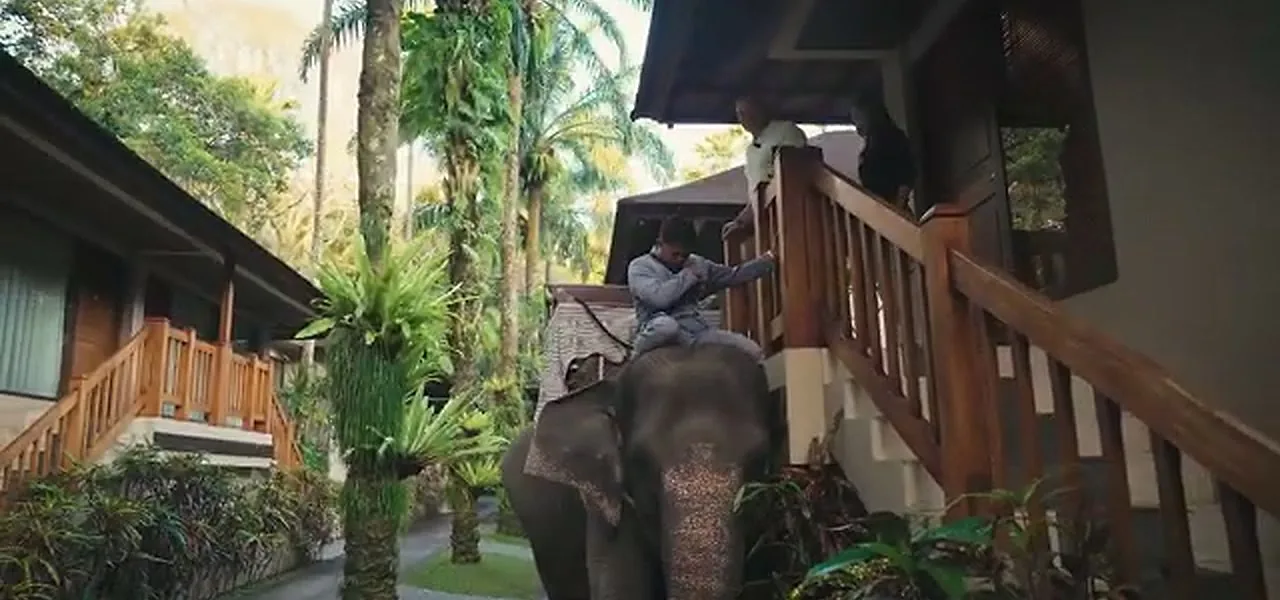
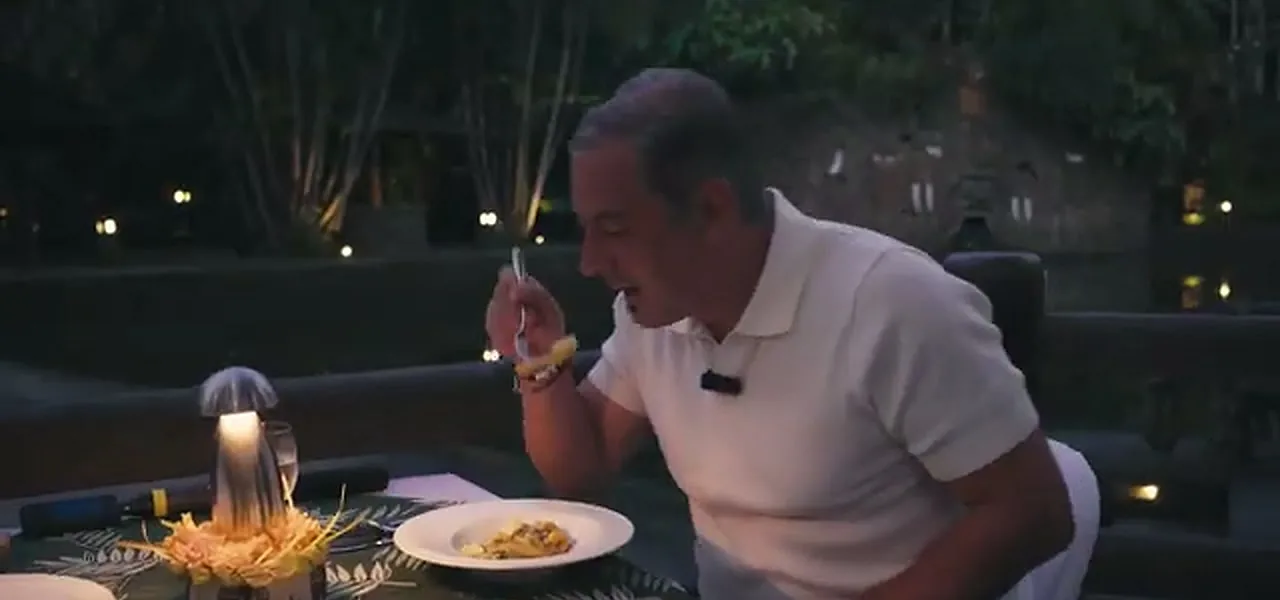
Nofi is a Sumatran elephant, a subspecies of the Asian elephant and one of the rarest large animals alive — fewer than 2,800 remain. The dinner itself was absurdly good: tuna salad, mushroom soup, a chicken-spinach-cheese roll, a grilled beef steak, and a choice of homemade apple strudel, berry compote or gelato. The staff made very sure I finished every bite, and told me why with a smile: tomorrow, they said, you'll have a lot to do with the elephants. Enjoy the evening.
One detail framed everything else for me. Every elephant at Mason has its own mahout — a single trainer who is paired with that animal and, in the traditional system, stays with it for the rest of its working life. It's not a shift job; it's a relationship measured in decades. The elephants themselves were rescued from Sumatra, the neighbouring island where logging and palm-oil plantations have swallowed most of their habitat, and where a wild elephant is as likely to be seen as a crop-raiding pest as a national treasure. Nigel and his family, the staff told me again and again, have loved animals their whole lives — and the wall of famous visitors who've passed through over the years is the park's quiet way of saying the world has noticed.
Washing a Small Grey Mountain
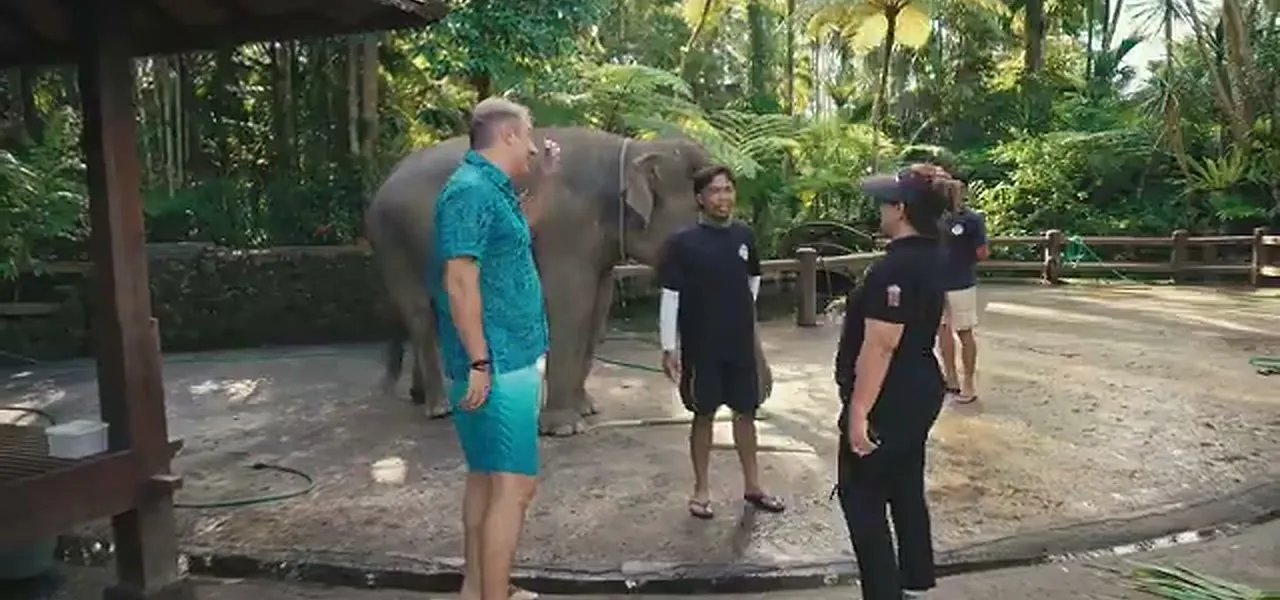
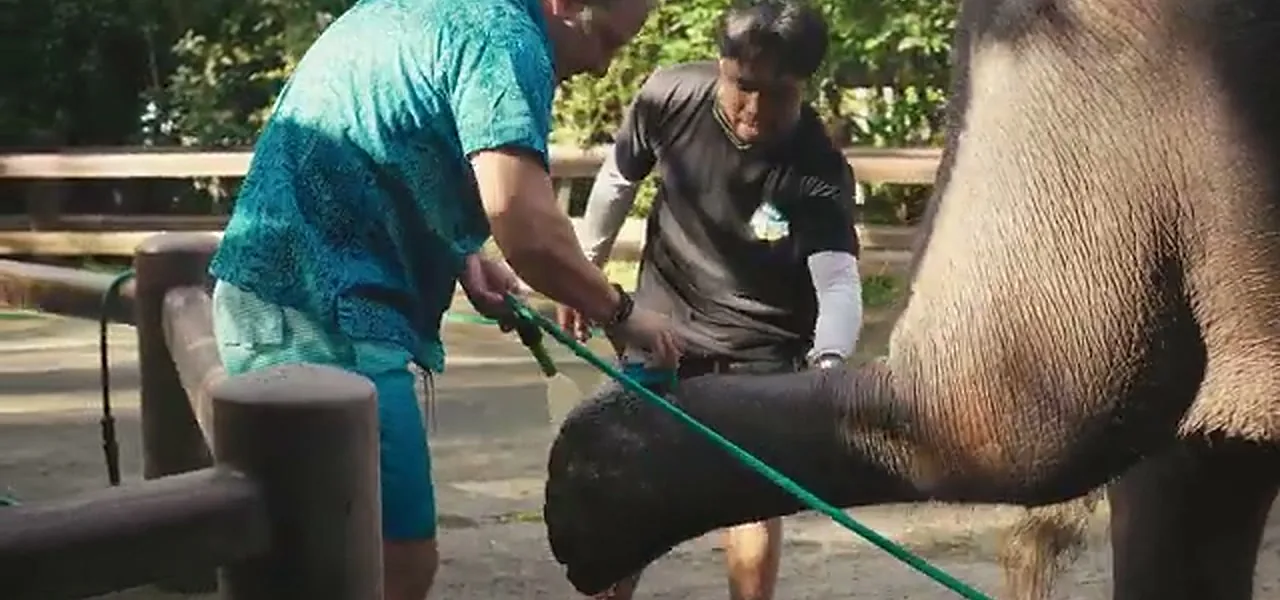
They weren't exaggerating. The next morning began with a hose, a brush and an elephant named Jay, born on the 15th of March — a few days off my own birthday, which felt like the right omen. To wash an elephant properly, the mahouts told me, takes about two and a half hours: you work the folds of the skin, the feet, the trunk, the great slab of the back. It is like scrubbing a small, affectionate mountain that occasionally decides it wants a cuddle.
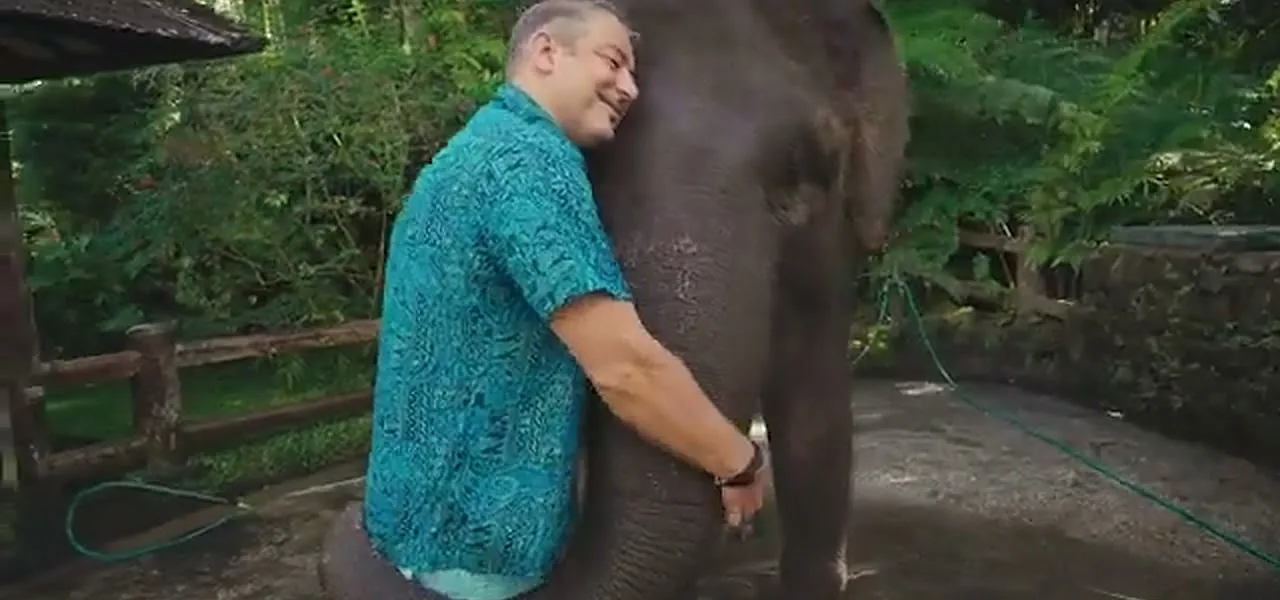
And then she hugged me. She looped her trunk around my shoulders and pulled me in, and whatever the strict zoological explanation, it did not feel like anything other than warmth. These are animals that live 60 to 70 years — longer here, the keepers say, than in the wild, where they're hunted and crowded out of shrinking forest. Standing inside that trunk, it was very hard to think of them as anything but individuals with long memories and real moods.
The Ride That Became Illegal
Then came the part that is now against the law. After the washing, they offered the jungle ride — the elephant walking a loop through the forest with me on top — and in the moment, in Indonesia, it felt like the thing to do. I'm showing it to you because pretending I didn't do it would be dishonest. But I owe you what I learned afterwards, because this is the knot at the centre of the whole story.
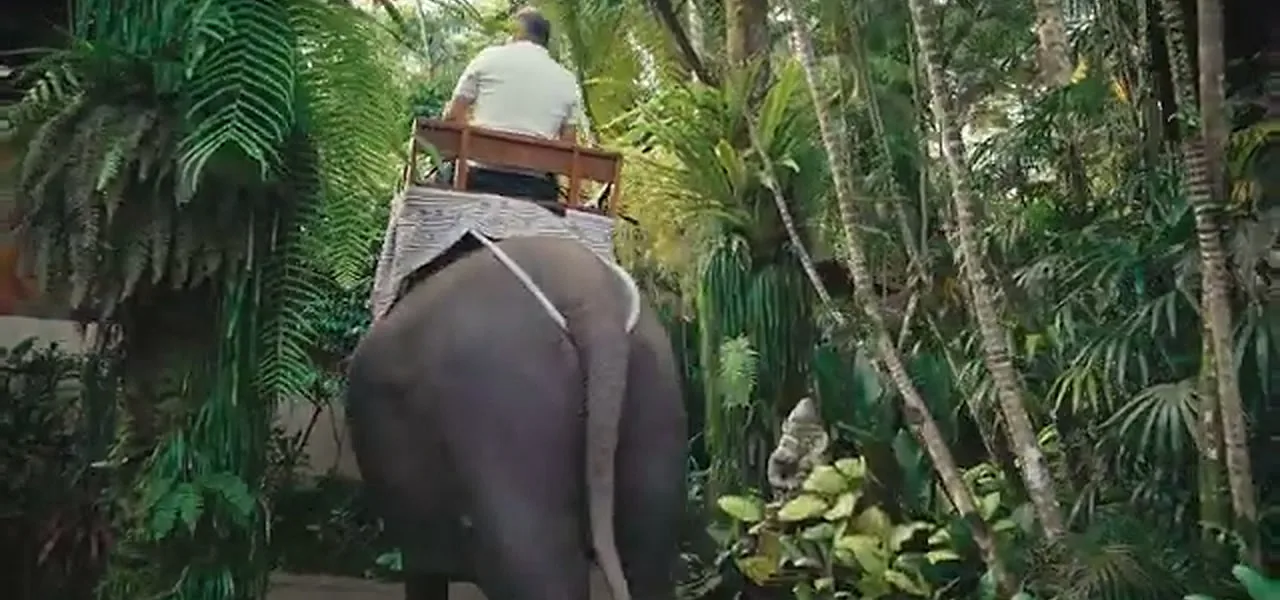
Here's the hard science. An elephant's back is not flat: under the skin runs a row of bony peaks, which is exactly why weight carried on top is the part welfare experts question. An elephant is built to carry underneath, not above. That's the case against riding, and it's a serious one. The park's case runs the other way: that gentle, limited walking keeps the animals conditioned, that the mahout never leaves the animal's side, and that a few hours of light work buys a lifetime of food, vitamins and veterinary care for a rescued animal with nowhere else to go. Both of those things can be true at the same time — and that is precisely what makes it hard.
I'm not here to tell you what to think. I'll tell you what I know. I was there, and this is exactly how it was. What you do with that is yours.
Swimming With Elephants, and Getting Painted
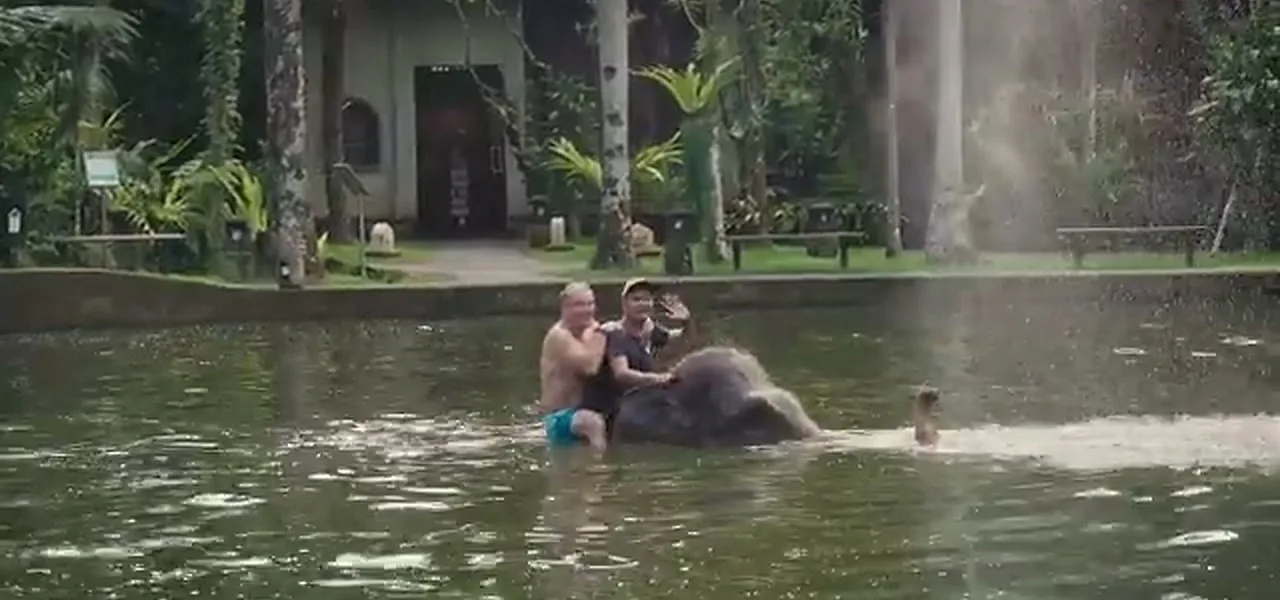
The day kept escalating. They led me to an enormous pond — the water drops to around four metres — and in went the elephant, and in went I. She sank until she was almost fully submerged, surfaced to blow and splash, and generally behaved like the world's heaviest, happiest swimmer. I have done a lot of unusual things for this show. Floating in deep water beside a Sumatran elephant is near the top of the list.
Then they told me to keep my old shirt on, and finally I understood why. The same elephant I'd washed that morning took a loaded brush in her trunk and painted — orange, then green, then red, across my shirt and, to my delight and alarm, my shorts. "No, no, it's the design," the keeper laughed, as I watched an elephant give me a wearable original. The Mason family even keeps a free art gallery and elephant museum on site, stacked with the paintings and the surprise gifts fans send from around the world.
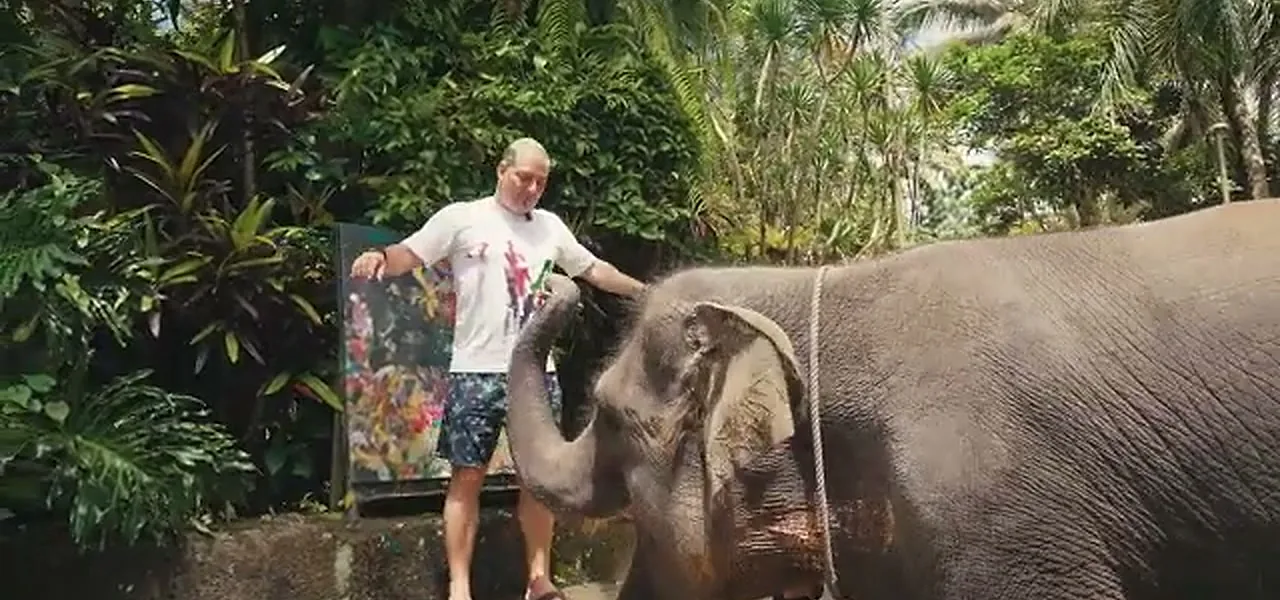
What stayed with me most, though, wasn't an activity. It was a keeper who had spent most of his life at this park, and who teared up mid-sentence trying to explain why he'd never leave. He loves the animals, the family, the place; he's nearly 53; he knows he can't stay forever. But his heart, he said, is here. You cannot fake that, and you cannot buy it. It's the thing that makes me believe the people at Mason mean what they say.
I don't know why I'm getting emotional. Maybe because I've been here so long and I love them. I love the family, I love the park. I can't stay here forever — but my heart is here.
Tortoises You're Actually Allowed to Touch
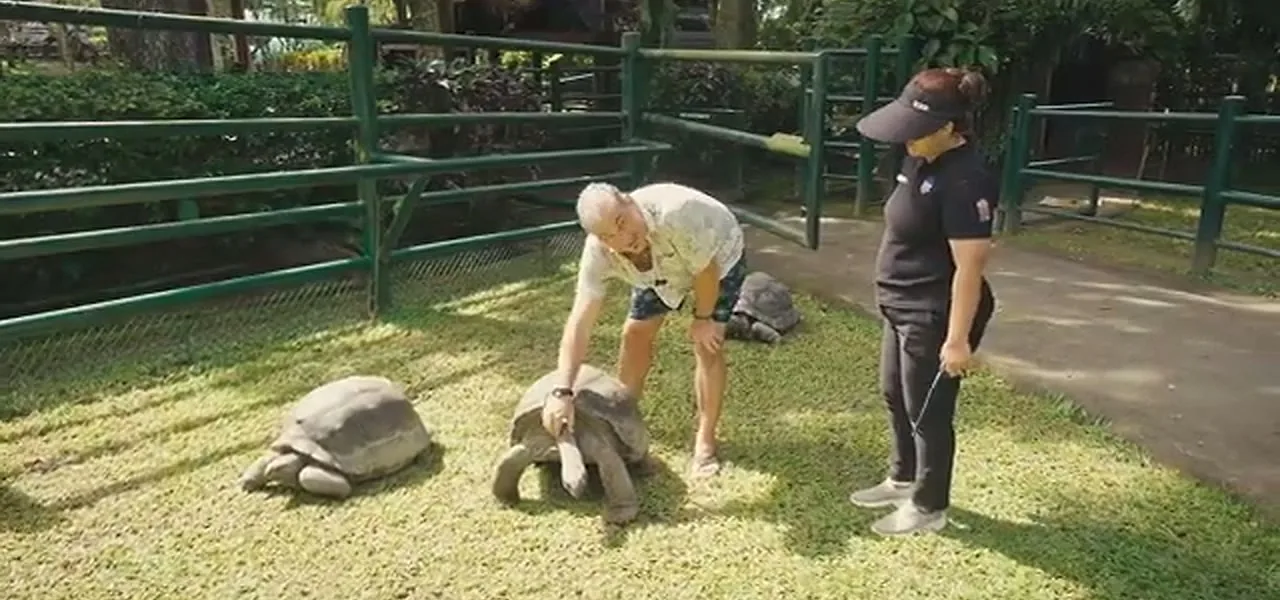
Mason isn't only elephants. In one corner live three enormous Aldabra giant tortoises, animals that can live a couple of hundred years. Here you're not just permitted to touch them — you're encouraged to pet and feed them, slowly and gently. One I met was a mere 14 years old. The contrast hit me hard, because I'd been to the Galápagos, where you cannot legally get within two metres of a giant tortoise, and here was one letting me stroke its ancient shell while it chewed a snack out of my hand.
The park has also raised six elephant calves of its own, the youngest a five-year-old named Krishna — and that fact opens its own debate about breeding animals in captivity, however kind the captivity. But with fewer than 2,800 Sumatran elephants left and most of their forest already cut down, there is, as one keeper put it to me, simply no door left to open. These animals cannot be returned to a wild that is disappearing. That is the uncomfortable reality underneath the entire conversation.
From Cocoa Tree to Chocolate Bar
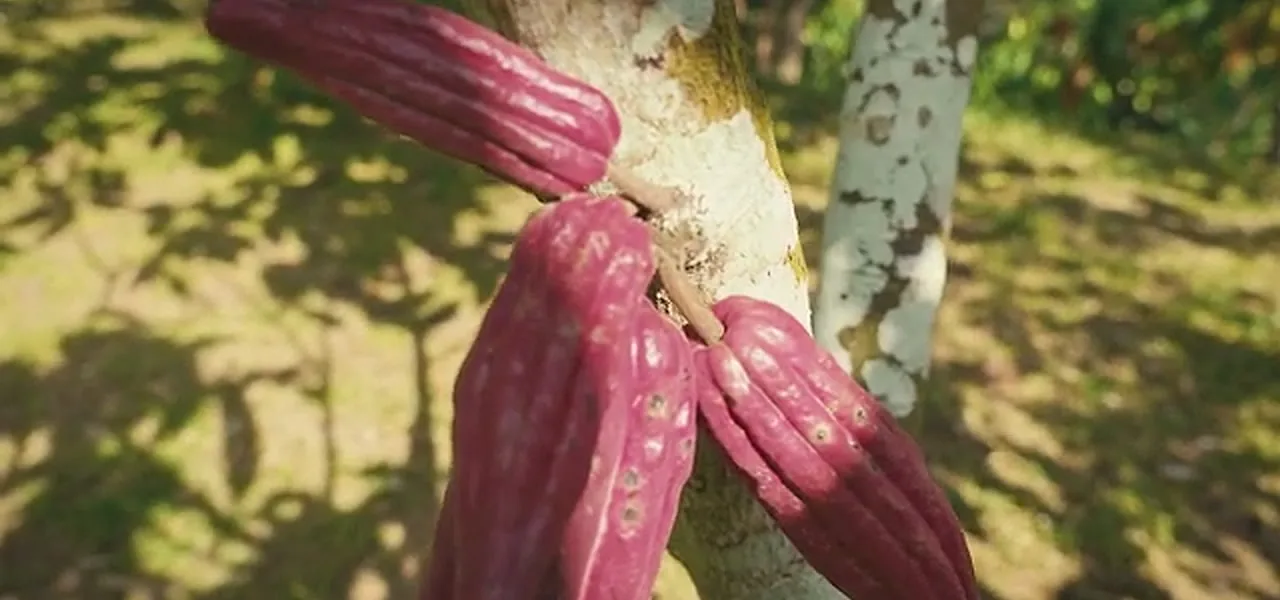
The Mason family runs one more thing I did not expect: a cocoa plantation and a chocolate factory, the whole journey from tree to box. My guide Putri walked me through the plantation, where the cacao pods ripen from green to orange over four or five months before harvest, and answered a question I'd genuinely wondered about my whole life — how you make white chocolate. The answer: you use only the cocoa butter, about half of each bean, plus sugar and milk. That's it.
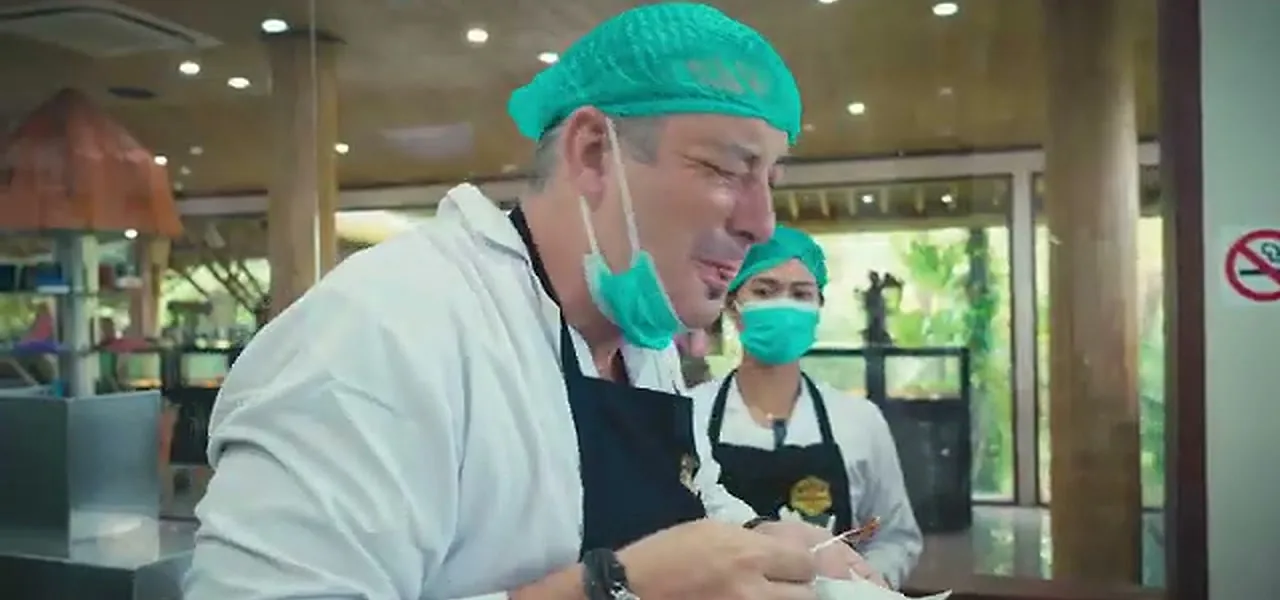
Inside the little factory we masked and aproned up like scientists — the hygiene was serious — and I watched the beans become chocolate: fermenting, drying, grinding, the butter and sugar going in. The surprise was the taste of the raw, young chocolate: shockingly bitter. The secret, they told me, is aging it, like wine — the dark chocolate you buy in a shop has typically been matured around nine months before it ever reaches you. I may have "tasted" rather more than the tour strictly required.
The Sacred Monkey Forest of Ubud
No trip to this part of Bali is complete without the island's most famous residents. Near Ubud, the Sacred Monkey Forest Sanctuary is home to over 1,260 Balinese long-tailed macaques living among temples and mossy statues, parts of it dating back to the 14th century. My guide Yessy walked me in, and it was less a park than a scene out of Avatar — monkeys everywhere, grooming each other, squabbling, watching you with frank curiosity.
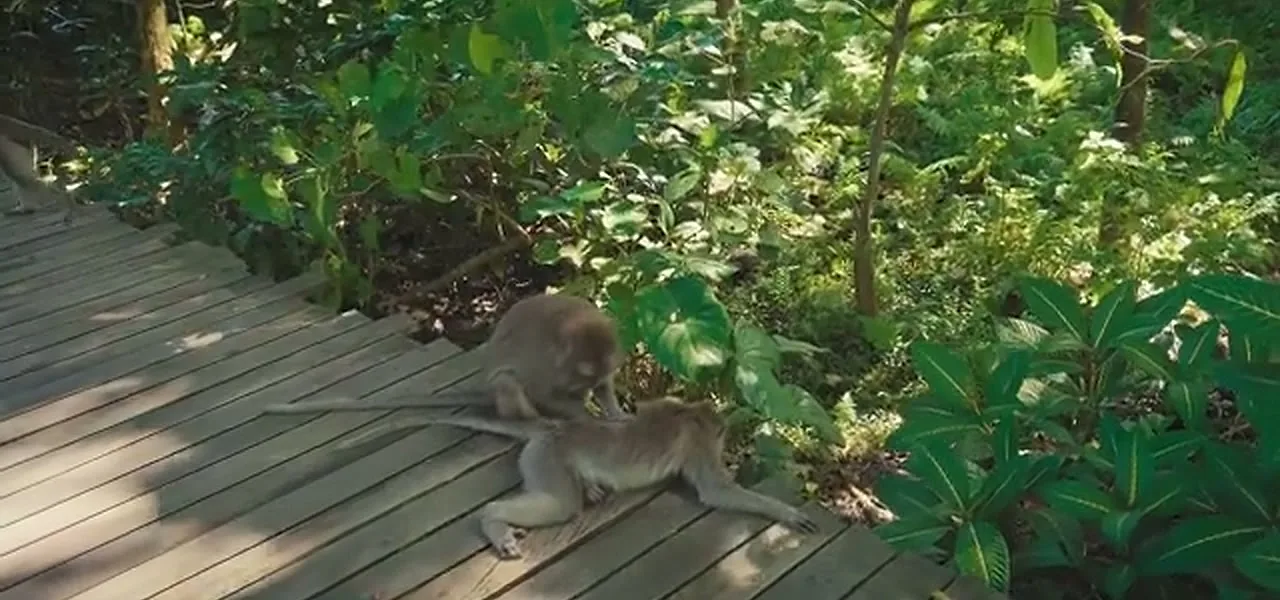
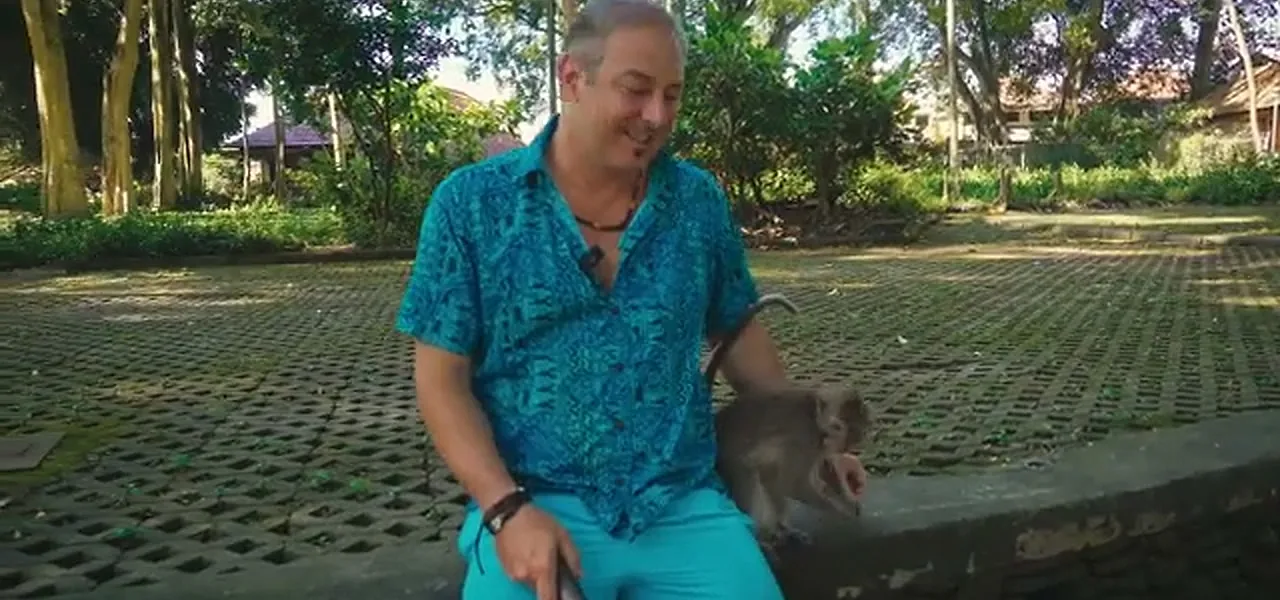
The rules are strict and sensible: don't feed them, don't touch them, and — the one that's hardest to obey — don't look them in the eye, because a direct stare reads as a threat and can get you attacked. Naturally, within minutes, one leapt onto my head and started hunting through my hair for snacks. Yessy said that to get her off I just had to stand up and she'd jump. I stood up. She stayed. She was, it turned out, extremely gentle, and simply wanted to hang out a while longer.
White-Water Through the Jungle
For a final jolt of adrenaline, the next morning I went white-water rafting — roughly 12 kilometres of river, meant to take about two hours, through some of the most beautiful scenery I saw anywhere in Bali. Just me, my cameraman and a guide on a small raft, dropping down rapids, pausing under waterfalls, and at one point jumping straight into water so deep there was no touching the bottom.
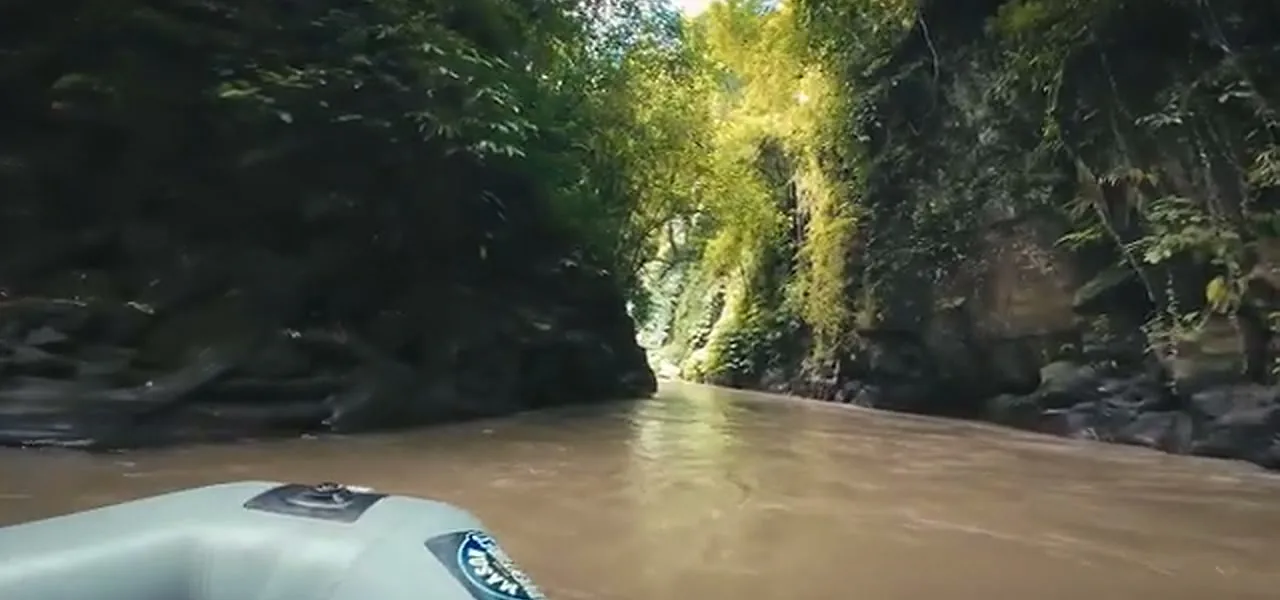
People describe rafting as a kind of therapy, and gliding through that green gorge, I understood it completely. The effort is gentle, the scenery does the work, and you climb out lighter than you got in. It was the perfect, energising full stop to a stretch of Bali that had already given me more than most trips give in a month.
By the numbers: Bali, by the numbers
- Sumatran elephants left
- Fewer than 2,800 in the wild
- Elephant lifespan
- ~60–70 years
- Washing an elephant
- ~2.5 hours, done properly
- Calves born at the park
- 6, the youngest aged 5
- Sacred Monkey Forest
- ~1,260 macaques · temples from the 14th c.
- White-water rafting run
- ~12 km · ~2 hours
- Chocolate, aged
- ~9 months, like wine
What Bali Left Me With
I left Bali before any of this changed. Soon after, the rides stopped — here and across Indonesia — and the elephants did exactly what everyone knew they would do: nothing. They can't go anywhere. So they are still being fed, still being washed, still being paid for by somebody. The single most expensive activity, the ride, is gone; everything else you've just read about still happens, every single day, and it still costs money nobody is collecting at a ticket booth anymore.
That's the piece I keep turning over. It's easy to end an elephant ride. It's much harder to fund the sixty years of care that an elephant needs afterwards, especially when a pandemic can erase your income overnight and a man has to sell his house to keep the animals fed. An adult elephant can eat its way through a staggering amount every day — these animals weigh up to four tons — and that bill does not pause when the tourists stay home or when a law removes your single biggest draw. The park's bet is that if you come for the dinner, the washing, the swimming, the painting, the gallery and the chocolate, your visit still pays for the feed, the vitamins and the vets. Take that revenue away entirely and the animals don't vanish; the cost just quietly lands on someone, somewhere, out of view. I'm not going to hand you a verdict. I'll just tell you that I was there, that I watched people love these animals in a way you can't fake, and that the honest questions are more interesting than the easy ones.
Bali gave me an elephant that took me to dinner, a monkey that moved into my hair, a tortoise older than my grandparents, chocolate aged like wine, and a river that felt like therapy. It also handed me the hardest question of the whole journey and, fairly, refused to answer it for me. That's travel. You don't always leave with a conclusion. Sometimes you leave with a better question.
My time in Indonesia wasn't quite finished — the island still had one more, almost unbelievable place to show me before the next dart flew. But that's a story for its own page.
Explore More Travel by Dart Journeys
- Back one island to Java, where this leg of the trip began, among temples, keris blades and ancient caves.
- See the archipelago from the water in the original Indonesia episode — Lombok, the Gili Islands and a phinisi sailing ship.
- Back to where this whole dart began, among the forts and mojitos of Puerto Rico.
- The giant-tortoise contrast I kept thinking about: the strict, wild rules of the Galápagos.
Suggested Sources & Further Reading
To go deeper into Bali, its elephants and the riding debate, these are some of the best authoritative resources:
- WWF — Asian elephant — status and conservation of the species, including the Sumatran subspecies.
- IUCN Red List — Sumatran elephant — the Critically Endangered assessment and population figures.
- World Animal Protection — elephants in tourism — the welfare case that drives riding bans.
- Encyclopædia Britannica — Bali — the island, its Hindu culture and Ubud.
- Sacred Monkey Forest Sanctuary (Mandala Suci Wenara Wana) — the official site for the Ubud forest.
All facts verified November 2026.
Bali: traveler questions
Can you still ride an elephant in Bali?+
No. Not long after I filmed, Indonesia became the first country in Asia to ban elephant riding, and that includes Bali. When I was there the ride was still legal, so you'll see it in the episode — and I've tried to be honest about the welfare arguments on both sides rather than preach. Everything else at Mason Elephant Park & Lodge still happens every day: washing the elephants, swimming with them, watching them paint, and the daily job of feeding animals that aren't going anywhere.
Is Mason Elephant Park ethical?+
It's the hardest question in the whole trip, and I won't pretend there's a clean answer. These are Sumatran elephants rescued from an island where most of their forest is gone and fewer than 2,800 of them remain; every elephant has a mahout who stays with it for life, and the park's position is that a few hours of gentle work buys a lifetime of food, vitamins and care. During the pandemic the founder, Nigel Mason, reportedly sold his own house in Australia to keep feeding the animals and paying the local staff. The rides have stopped, the elephants remain, and someone still has to pay to feed them. I'll tell you what I saw and let you decide.
Where did Sorin stay in Bali?+
At Mason Elephant Park & Lodge in Taro, near Ubud in central Bali — a lodge built right inside an elephant sanctuary, where an elephant can literally pick you up at your door and walk you to dinner. The same family also runs a cocoa plantation and chocolate factory, a free art gallery and elephant museum, and giant Aldabra tortoises you're actually allowed to touch and feed.
What else is there to do in Bali beyond the elephants?+
Plenty, and I packed in as much as I could. Near Ubud I visited the Sacred Monkey Forest Sanctuary, home to over 1,200 Balinese long-tailed macaques around temples dating back centuries, and I went white-water rafting roughly 12 km down a jungle river past waterfalls. Bali is Indonesia's Hindu island — temples, rice terraces and ceremony everywhere — and Ubud is its cultural and spiritual heart.