Season 3 · Episode 11
Antarctica
The seventh continent — a land owned by no one, kept for peace and science.
On this page ▾
By Sorin Mihailovici · Travel by Dart · Last updated August 2026 · ~15 min read
The dart that sent me to Antarctica was thrown years before I ever set foot on the ice — and I wasn't the one who threw it. Back when Travel by Dart was still just a lifestyle two friends shared, not a show, I did it alongside one of my best friends, Matt. One evening, each of us threw. I hit Easter Island. Matt hit Antarctica — and I remember teasing him mercilessly about how absurdly far away it was. Then life happened. Matt ran into problems and couldn't continue the show, so I carried it on alone, episode after episode, because it was my idea and my dream. But that throw of his stayed lodged in the back of my mind. So one day I called him and said: remember when you hit Antarctica? We should actually make that happen. We partnered with the expedition company Polar Latitudes and finally booked it — his throw, our trip.
It didn't work out the way we planned. Flying south to meet me, Matt got as far as Argentina before disaster struck: in Chile, someone stole his bag with his laptop, wallet and passport inside. He spent 72 hours dealing with the consulate and had to buy an emergency ticket back to Canada. He never made it. So I did the whole thing alone — heartbroken for my friend, and at the same time overwhelmed, because this was the trip of a lifetime and the continent that would complete my seven. I'll be honest about something else, too: when the dart first pointed here, I wasn't excited. Antarctica felt cold, remote, and hard. By the time I left, it had quietly become one of the most important places I've ever been.
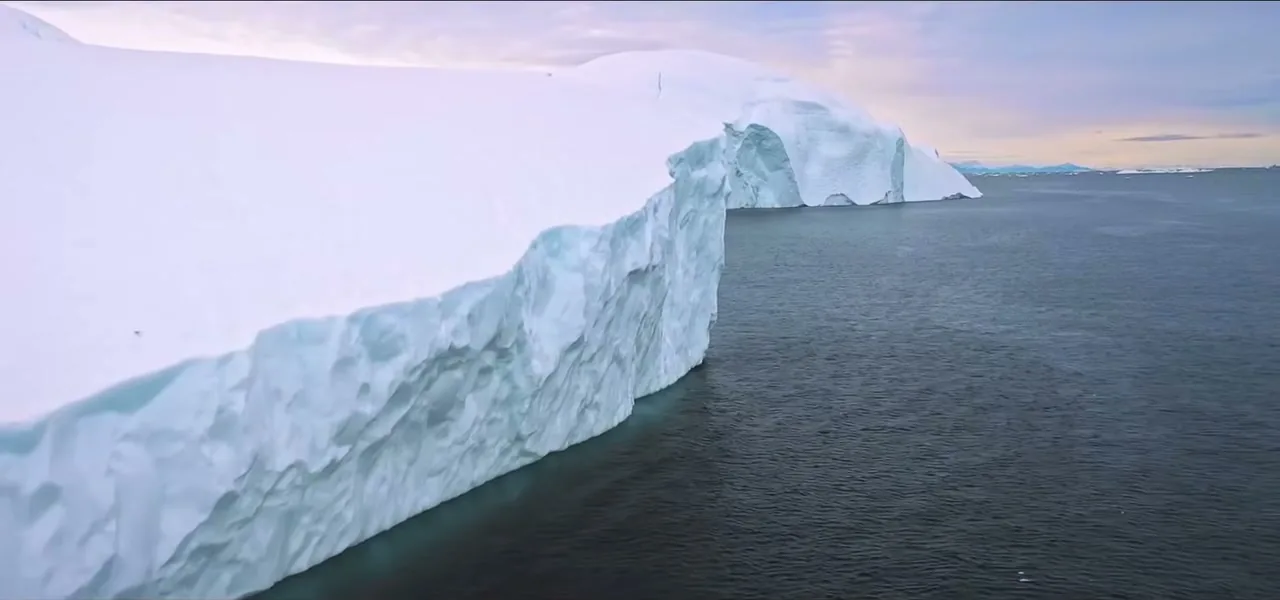
Quick facts: Antarctica at a glance
- Status
- No owner — governed by the Antarctic Treaty (1959)
- Purpose
- A continent reserved for peace and science
- Gateway
- Ushuaia, Argentina — the world's southernmost city
- The crossing
- Drake Passage — ~2 days of open ocean
- Ice
- ~98% ice; holds ~70% of Earth's fresh water
- Coldest recorded
- −89.2°C (−128.6°F) at Vostok, 1983
- Wildlife
- Penguins, whales, seals, seabirds — no polar bears
- Season
- November–March (Antarctic summer)
The End of the World and Its Prison
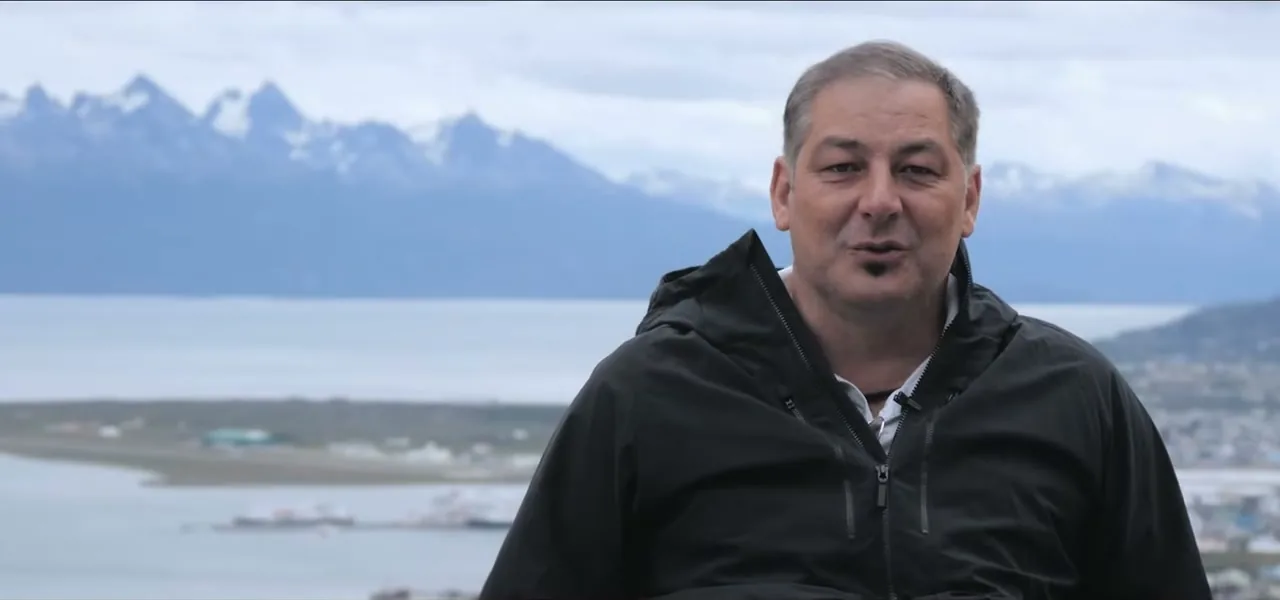
Every Antarctic journey starts in the same place: Ushuaia, the southernmost city in the world, at the tip of Argentina's Tierra del Fuego. Flying in, you see the island, the harbour and a wall of jagged mountains, and down at the port there's the famous sign — Ushuaia, el fin del mundo, the end of the world — where everyone stops to get in the mood before sailing. Expeditions have you arrive two or three days early, deliberately, so a delayed flight only costs you a hotel night instead of the whole voyage. That gave me time to look closer at the town — and to find the strangest fact about it.
Ushuaia exists because of a prison. In the late 1800s the Argentine government wanted to cement its claim over this remote, empty land, and the way it chose to do that was to build a penal colony and ship the country's most dangerous criminals to the very bottom of the map. The first inmates arrived in 1896, and construction of the jail itself began in 1902. Around the prison grew the staff, the supply lines, the logistics — and, eventually, a town. The jail is a museum now, its most notorious inmates absorbed into local pop culture, their faces painted on walls around the city. It's a genuinely odd thought to hold as you board a luxury expedition ship: this flourishing port at the end of the world was founded as a place to exile people no one else wanted.
Crossing the Drake Passage
From Ushuaia you sail for two full days — about 48 hours — without stopping, straight across the Drake Passage. This is the body of open water between the southern tip of South America and the Antarctic Peninsula, where the Atlantic, Pacific and Southern Oceans collide with nothing to break them, and it has a fearsome reputation. Sailors have a saying: if you haven't crossed the Drake at least once, you're not a real seaman. One crew member told me he'd done more than a hundred crossings and had worked out that he'd spent, in total, a full year of his life in the Drake Passage alone.
My captain was Nino, from Croatia, who showed me the ship with obvious affection and referred to it, as sailors do, as she. He explained that down here you rely far more on improvisation and pure seamanship than on ports — you're at sea almost the entire time. The Drake, everyone agreed, is really a question of luck and weather: there's always a storm in the Drake Passage, one guide told me. It's just a matter of whether you're in front of it or behind it. You make a plan, but you keep it flexible, always ready to be blown off one route and slip onto another. I got lucky — some big waves, nothing terrifying — and after two days the reward appeared: at 7 p.m., the land of Antarctica finally rose out of the sea.
Who Actually Owns Antarctica
Here's the fact that surprises almost everyone: nobody owns Antarctica. There's no government, no citizenship, no border guard stamping passports. Instead the entire continent is governed by the Antarctic Treaty, signed in 1959 and in force since 1961 — an extraordinary document of just 14 articles whose central premise is that Antarctica shall be used for peace and science only. It bans military activity, forbids nuclear testing, and freezes every national territorial claim in place. It began with twelve nations and now binds more than fifty. It is, arguably, the most successful piece of international cooperation humanity has ever managed — an entire continent that we collectively agreed to leave alone.
The name is older than the discovery. The ancient Greeks never saw this place, but they reasoned that the far north — which they named the Arktos, after the Bear constellation overhead — ought to be balanced by a landmass at the opposite pole. So they called that theoretical southern land the Antarktikos: the "opposite of the Arctic." When real explorers finally arrived, the name was waiting for them. William Smith sighted the South Shetland Islands in 1819 and was so disbelieved back home that he had to sail down and prove it a second time; decades earlier, James Cook had circumnavigated the whole continent in the 1770s without ever laying eyes on the land itself. Antarctica is the only continent named before anyone knew for certain it was there.
First Steps on the Seventh Continent
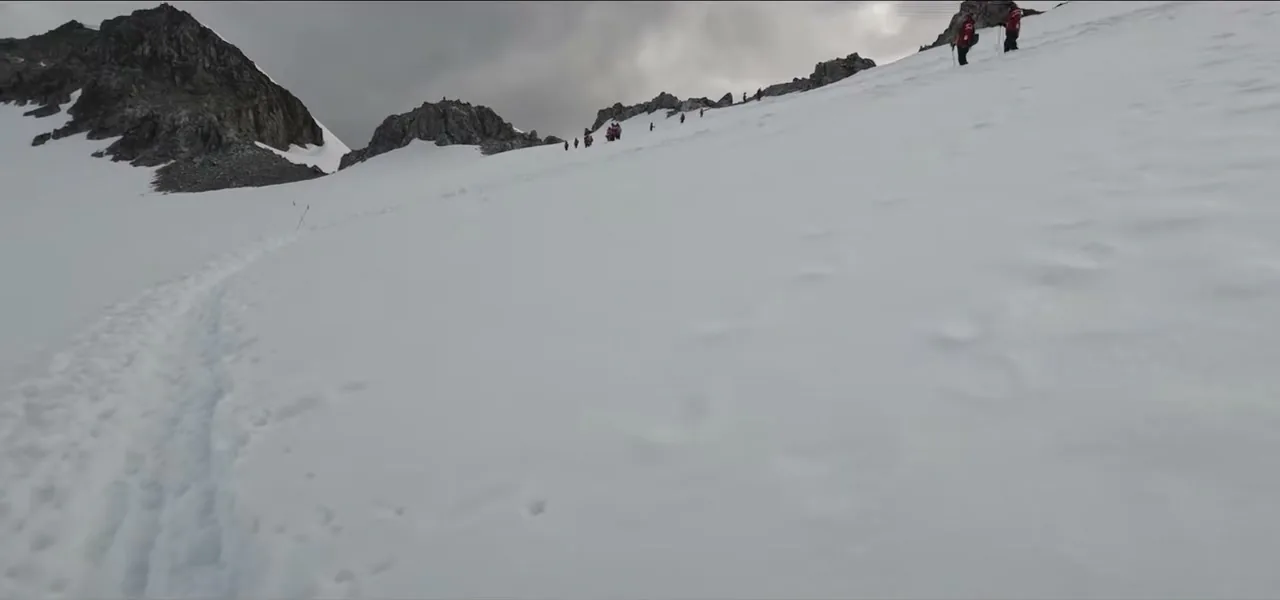
Before you're allowed to set foot on the continent, you go through biosecurity. The crew vacuums your bags and inspects the soles of your boots, picking out every trapped pebble and seed, so that not a single foreign species or spore travels ashore with you. It's slow and fussy and completely worth it: this is the most pristine environment left on the planet, and the whole point is to keep it that way. My first landing was at Orne Harbour, where a colony of about a hundred penguins put on a show — falling over, standing up, waddling around — and where, properly dressed, you could happily lose an entire day just watching the light on the ice.
What I didn't expect was to become a scientist. Polar Latitudes runs a Citizen Science Program in partnership with the Polar Collective, and it turns ordinary passengers into genuine contributors to research — logging cloud cover for satellite calibration, lowering a Secchi disk to measure water clarity, sampling phytoplankton, photographing whales for global catalogues. I fell completely in love with the idea. You don't need a PhD to make a difference; you just need to be here, paying attention, and willing to write down what you see. It reframed the whole trip. I wasn't a tourist gawking at the scenery — I was, in some tiny way, helping to keep track of it.
The Truth About Penguins
For most people, penguins are the whole reason to come, and they do not disappoint — but almost everything you assume about them is a little off. First, the myth I heard most: penguins and polar bears do not live together. Penguins are found only in the Southern Hemisphere (the one exception, the Galápagos penguin, occasionally noses across the equator); polar bears live only in the Arctic. They are separated by the entire planet, and the Christmas cards that put them side by side are pure fiction.
A penguin is a bird — it lays eggs and raises chicks like any other — but a flightless one, and the fastest-swimming seabird there is. Their black-and-white colouring isn't decoration; it's countershading camouflage. To a predator looking down from above, the dark back blends into the deep water below; to prey looking up from beneath, the white belly disappears into the bright sky. On Danco Island I watched them build their famous "penguin highways" — trodden little boulevards packed into the snow between the sea and their nests — and hiked up to a plateau with a 360-degree view of the surrounding islands. Danco alone holds 2,506 nesting sites, and since each site means two adults plus their chicks, that's well over 5,000 Gentoo penguins in one place. The rule here is absolute: you may not drop a thing, and you are not even allowed to squat — you leave no mark at all.
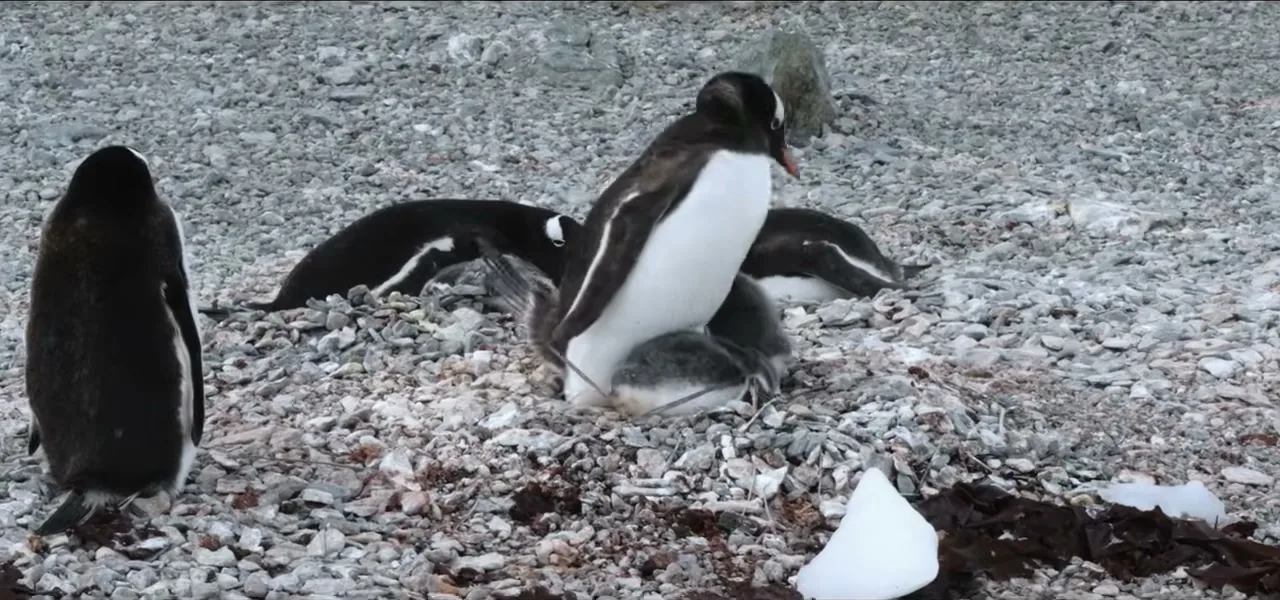
There are 18 known species of penguin, and five — possibly six — breed in Antarctica: Adélie, Chinstrap, Gentoo, Emperor and Macaroni, with the King penguin recently spotted trying to join the list. The researchers I met count them the old-fashioned way, with a handheld clicker and a notebook, tallying occupied nests because a bird sitting on a nest holds still long enough to be counted accurately. The numbers are staggering: something like 1.3 to 1.5 million pairs of Adélie penguins on the peninsula, roughly 4.5 million individual Adélies across Antarctica proper, about 220,000 breeding pairs of Emperors, and around 200,000 pairs of Gentoos — the Gentoos expanding so fast that they're now elbowing other species out of prime nesting sites.
By the numbers: Antarctica's penguins by the numbers
- Known penguin species worldwide
- 18
- Species breeding in Antarctica
- 5, possibly 6
- Gentoos on Danco Island
- 5,000+ (2,506 nesting sites)
- Adélie pairs on the peninsula
- ~1.3–1.5 million
- Emperor penguin breeding pairs
- ~220,000
- How they're counted
- By hand — a clicker and a notebook
None of this counting is idle. The nonprofit Oceanites has been tallying Antarctic penguins for 30 years, feeding hard numbers to the policymakers who make conservation decisions. Penguins are a barometer: they eat krill, and krill — vast in number and central to the carbon cycle — respond to a warming ocean. Watch the penguins closely enough, over enough years, and you can read the health of the entire Southern Ocean in them. Bringing travellers down to witness it, and to feel the reach of their own faraway habits, is part of the point.
Part Two: Whales, Camping and the Plunge
If part one was ice and penguins, part two is where Antarctica turned into something I'll never forget — whales at arm's length, a night sleeping in the snow, and a jump into water cold enough to stop your breath.
▶ Antarctica — Camping on Ice, the Polar Plunge & Curious Whales
Part two: whales up close, a night camping on the peninsula, the polar plunge, kayaking and the dart throw
The Whales of Antarctica
The first Zodiac cruise dedicated to whales delivered instantly — humpbacks surfacing, exhaling, rolling, one appearing right beside the boat. On board we had a whale specialist, Therese, and the facts she shared were as astonishing as the animals. Whales evolved from land, she explained: their ancestor was a small, four-legged land mammal — Pakicetus — that walked the Earth roughly 50 million years ago before its descendants returned to the sea. Today's whales split into two families. Baleen whales — including the blue whale, the largest animal that has ever lived — have no teeth but curtains of keratin plates; they take an enormous mouthful of water, up to 80,000 litres in a single gulp, then squeeze it out through the baleen and swallow the krill left behind. Toothed whales are the hunters, chasing fish, seals, even other whales.
The details of their lives are almost unbelievable. Whale calves are born tail-first, so the fluke can stiffen in the water before the newborn needs to reach the surface for its first breath. Whale milk has the consistency of toothpaste — the mother essentially squirts it into the calf's rolled tongue underwater — and a blue whale calf drinks around 400 litres of it a day. Humpbacks run 13 to 16 metres long; a blue whale can reach 30. And every one of them can be identified individually: for a humpback, the underside of the fluke is a fingerprint, unique to that animal, while for an orca it might be the eye patch or the dorsal fin.
A Night Camping on the Ice
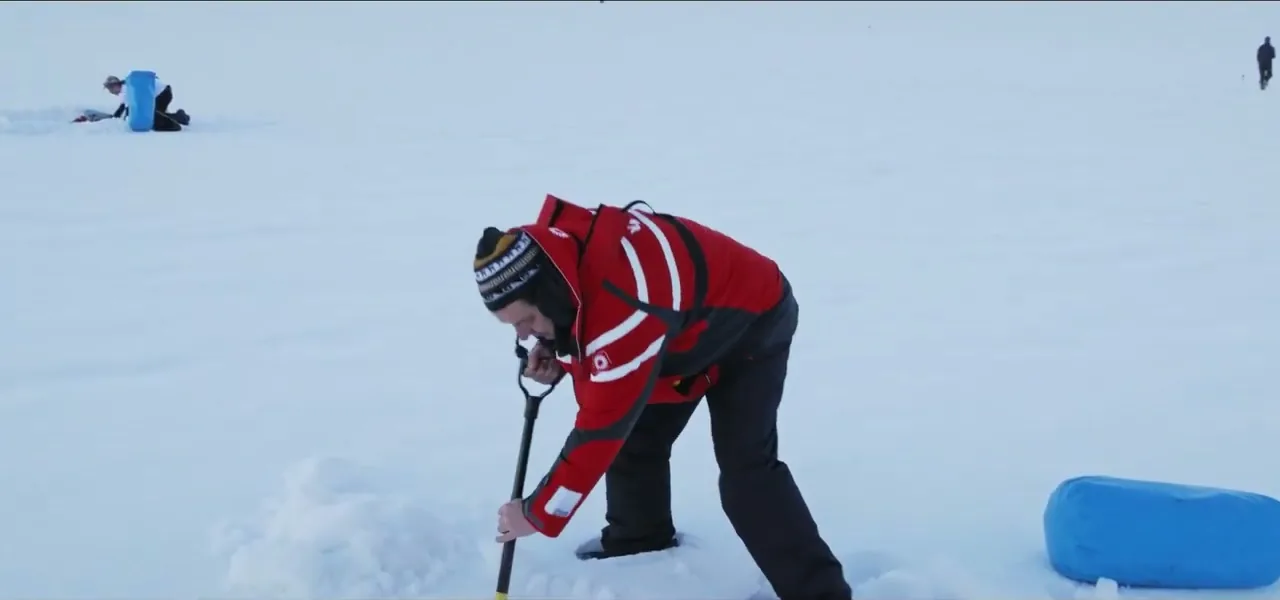
Of everything on offer, the excursion I most wanted was camping on the continent — leaving the ship for an entire night to sleep out on the peninsula with about 50 other people. There are no tents in the usual sense. You're handed a five-piece kit — a ground tarp, an inflatable mattress, a bivy cocoon, a sleeping bag, a liner sheet — and then you build your own bed by digging a shallow trench in the snow, maybe 15 inches deep, to shelter you from the wind. We took turns with a handful of shovels, everyone carving out their own little rectangle while an unreal sunset lit the mountains in front of us. It genuinely felt like a fairy tale: this small, self-selected group of people, quiet, spread across the snow, about to spend the night in one of the emptiest places on Earth.
The night itself was, let's say, character-building. I woke at 5 a.m. to the sound of footsteps crunching on frozen snow — everyone packing up. My boots were frozen solid, my bag was stiff with cold, and at some point in the night my mattress had quietly deflated, so I'd been lying straight on the ice. As I put it at the time: I froze my bum off. And I would do it again in a heartbeat. When we left, the rule held — you leave no trace — and looking back at the flat, unbroken snow, you truly could not tell that 50 people had just slept there. It's the kind of thing you do exactly once in a lifetime and remember forever.
The Polar Plunge
As the days passed, the conversation on board shifted from penguins and whales to one looming event: the polar plunge. The idea is simple and slightly insane — you jump into the Antarctic ocean, water temperature hovering right around 0°C, even −1°C, with a skin of ice forming on the surface. The day it happened was the worst-weather day of the trip, the only day it snowed, and I was floored to learn that more than half the passengers did it anyway. After a night freezing in my jacket while camping, I figured the only thing worse than freezing with your clothes on is freezing with them off — so I jumped.
My very first dart ever landed near the North Pole, and I took a polar dip in Svalbard. Now I'd done it again at the bottom of the world. One plunge at each pole — which, I suppose, officially makes me a bipolar plunger.
The truth is I felt fantastic for the rest of the day. It's a jolt of adrenaline and the pure thrill of doing something you've never done — a full-body flush of cold that leaves you buzzing for hours. There was only one ladder back into the water, which meant timing mattered: my expedition-mate Phil got stuck treading freezing water for a full 30 seconds waiting his turn while I scrambled straight back out. I recommend it to absolutely everyone, at least once. Or, in my case, twice.
Kayaking and the Post Office at the End of the World
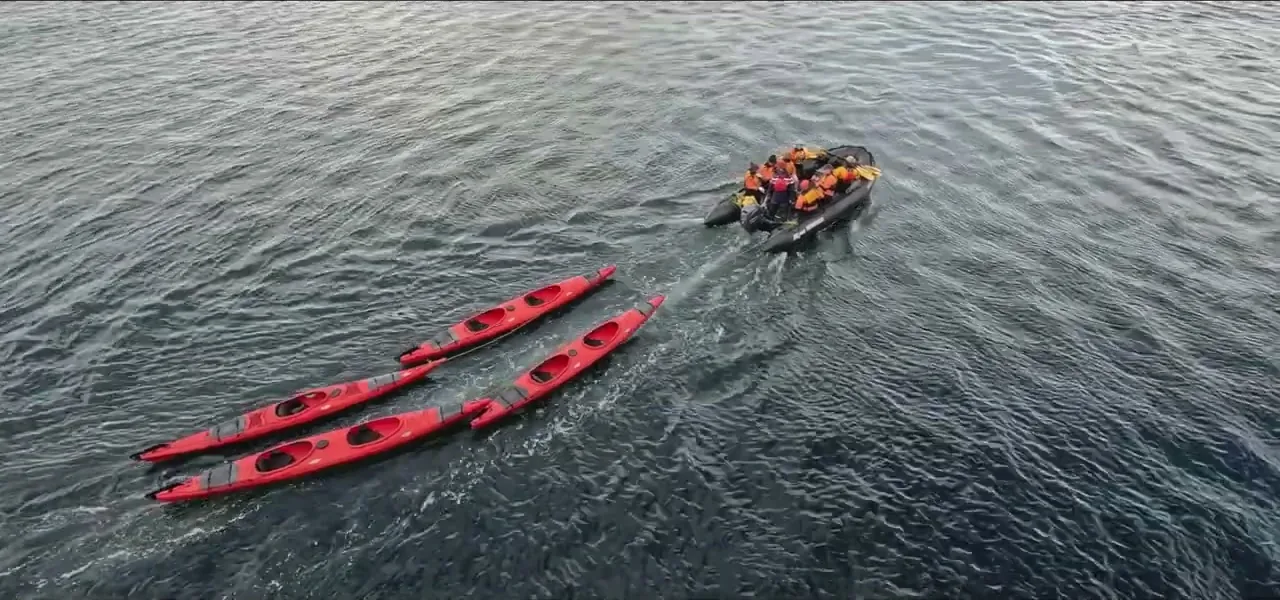
That same afternoon I went kayaking, which turns out to be the perfect way to meet Antarctica — down at water level, eye to eye with the ice. These sea kayaks were bigger than the ones I'd paddled in the Galápagos, steered from the back seat, with clever mittens fixed right to the paddles so that even soaking wet your hands stayed warm. Our guide, Santi, led us five or six kilometres through the islands over about two hours, past some of the most beautiful icebergs I've seen anywhere, in photos or in life. I paid for it the next day in muscles I hadn't used in years — and promised myself I'd kayak more from now on.
We paddled past Port Lockroy, the famous British base turned museum and post office on tiny Goudier Island, where visitors get a souvenir Antarctic stamp in their passports. It was closed as we passed — but the staff, wonderfully, sent a couple of people out to our ship instead, so we got our passports stamped on board. It doesn't look like much; it just says Antarctica. It might be the single stamp I'm proudest of.
The Dart Thrown From the Bow
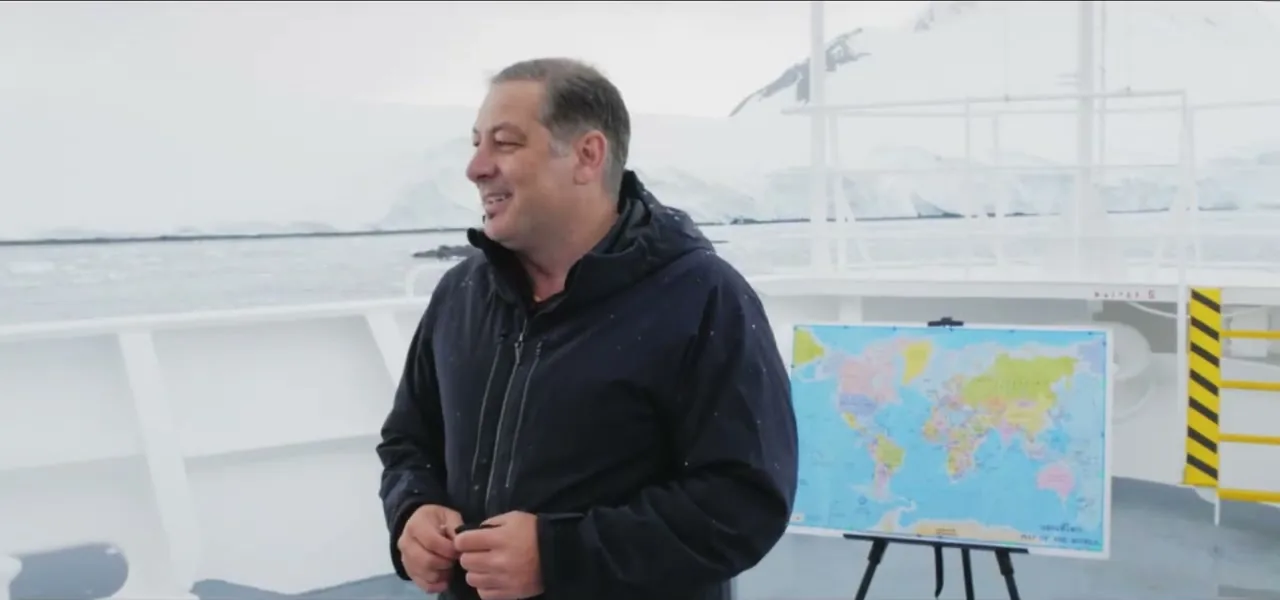
Every Travel by Dart journey ends the same way, and even at the bottom of the world the ritual had to be honoured: I had to throw a new dart at the map and go wherever it landed. This time was different, though — for the first time, I had an audience. The whole ship had been asking for days when I'd do it, so after consulting the captain and crew we chose the most dramatic stage imaginable: the bow of the ship, Antarctic wind and all. I explained my rules to the crowd — miss the map and I throw again; hit a country I've already been to and I throw again; hit ocean and I go to the nearest land. My real worry was that with roughly 40 countries already behind me, the odds of landing somewhere new were getting slim.
I needn't have worried. Blindfolded, I threw — and the dart landed right on the border of Benin, Togo and Burkina Faso, in West Africa. Africa is a continent I've long wanted to explore properly, so I couldn't have been happier: somewhere genuinely new, chosen entirely by chance, in front of a cheering shipful of people. I'd figure out which of the three it would be later, back on dry land, with a map and some research. For now it was enough to know the next chapter would be somewhere I'd never been.
Ten Days at Sea, and a Secret on Board
By the end, ten days at sea had turned a shipful of strangers into friends. There was a dance party almost every night — mix an open bar with a talented resident artist named Randy and you get a genuine hoot — plus karaoke, long dinners, and late nights at the bar. I spent many of those dinners next to a friendly, unassuming man named Robert, and only well into the voyage did the truth come out: Robert owned the ship. He'd told no one. He simply wanted to experience Antarctica as an ordinary guest, and asked to be treated exactly like everyone else. The SeaVenture was built in Japan in 1990, with an ice-strengthened hull for the polar regions — smaller than the newest ships, he said, but tougher.
The expedition, by the numbers
The Continent That Changed My Mind
On my last day, one of the team, Lori, quietly took my hand and pressed something into it: the Antarctic insignia, a pin they don't give to everyone. I'll be honest one more time — I did not want this throw when the dart first chose it. Antarctica sounded cold and difficult and far, and I nearly resented it. Getting here changed my perspective completely. In a world that seems to get louder and crazier by the day, this silent, spotless continent — owned by no one, kept for peace and science, home to millions of penguins and no borders at all — is the most refreshing place I can imagine.
This trip completed my seven continents, and it did far more than tick a box. To me, life is a collection of memories, and Antarctica handed me a set that very few people will ever hold: whales beside a kayak, a night in a trench in the snow, a plunge into freezing water, a dart thrown from a ship's bow into open ocean. I told everyone this was a once-in-a-lifetime trip. I've since changed my mind about that, too — I fully intend to go back. If you've ever thought about standing on the seventh continent, take this as your sign. And if you want to see where the dart pointed me before all this, start with the Iceland episodes and the Galápagos — and watch both Antarctic parts above.
Explore More Travel by Dart Journeys
- See where the dart pointed me before the ice: the Iceland episodes.
- The wildlife wonderland the dart chose earlier: the Galápagos.
- The frozen north, its mirror image: my Finland journey into Lapland.
- Another end-of-the-world adventure the dart handed me: Patagonia and Argentina.
Suggested Sources & Further Reading
To go deeper into Antarctica, these are some of the best authoritative resources:
- Secretariat of the Antarctic Treaty — the treaty that reserves the continent for peace and science.
- IAATO — International Association of Antarctica Tour Operators — the body that governs responsible Antarctic tourism.
- British Antarctic Survey — leading polar science and research.
- Encyclopædia Britannica — Antarctica — an authoritative overview of the seventh continent.
All facts verified September 2026.
Antarctica: traveler questions
Who owns Antarctica, and do you get a passport stamp?+
No country owns Antarctica. It's governed by the Antarctic Treaty of 1959 — 14 articles that set the entire continent aside for peace and science, ban military activity, and freeze all territorial claims. There's no border control and no official stamp, but the historic British post office at Port Lockroy will ink a souvenir Antarctica stamp in your passport.
How do you actually get to Antarctica?+
Almost everyone sails from Ushuaia, the southernmost city in the world, at the tip of Argentina's Tierra del Fuego. From there an expedition ship crosses the Drake Passage — the roughly two-day, notoriously rough stretch of open ocean between South America and the Antarctic Peninsula — before reaching the ice. I travelled with the expedition operator Polar Latitudes aboard the SeaVenture.
What animals will you see in Antarctica?+
Penguins are the headline — Gentoo, Adélie and Chinstrap colonies thousands strong, plus Emperor and Macaroni. You'll also see whales (humpbacks are the most common, along with the occasional minke or orca), several species of seal, and huge numbers of seabirds. There are no polar bears — those live only in the Arctic, at the opposite end of the planet.
Can you really camp on the ice and do a polar plunge?+
Yes — most expedition ships offer both. Camping means digging a shallow trench in the snow and sleeping in a bivy sack under the Antarctic sky, leaving no trace behind. The polar plunge is a quick jump into water hovering around 0°C / 32°F. On my voyage more than half the passengers did the plunge, snow and all.
When is the best time to visit Antarctica?+
The season runs roughly from November to March, the Antarctic summer. Early season (November) brings pristine snow and courting penguins; December–January has the longest days and warmest temperatures; late season (February–March) is best for whales, as feeding humpbacks gather in numbers. Outside those months the sea ice makes tourism impossible.
Is Antarctica cold and dangerous for travellers?+
The Antarctic Peninsula in summer is milder than people expect — often hovering around freezing rather than the brutal cold of the interior. The real challenges are the Drake Passage crossing and the weather, which dictates every landing. Expedition teams plan around it constantly, and with proper gear and guidance it's a remarkably safe way to see the most extreme place on Earth.