Season 3 · Episode 5
Crete
Greece's largest island — birthplace of Europe's first civilization, and a world unto itself.
On this page ▾
By Sorin Mihailovici · Travel by Dart · Last updated August 2026 · ~18 min read
Of all of Greece's thousands of islands — over 6,000 of them, though only around 227 are inhabited — one stands apart, and its own people will not let you forget it. I came to Crete at the end of my Greek adventure, after Athens and Delphi and the dark history of Thessaloniki, and I was met almost immediately by a sentiment I'd hear again and again: "Cretans first, and then Greeks — but we are the best Greeks. You understand?" It's said with a grin, but they mean it. To be Cretan, one man told me, you have to think like a Cretan, act like a Cretan — and show off a little while you're at it. What followed was, honestly, one of the most joyful, exhausting, back-in-time weeks the dart has ever handed me.
Quick facts: Crete at a glance
- Status
- Greece's largest island
- Size rank
- 5th-largest in the Mediterranean
- Population
- ~625,000
- Main city
- Heraklion
- History
- ~5,000 years, from the Minoans on
- Famous for
- Knossos, music, raki, hospitality
- Signature drink
- Raki (tsikoudia)
- Local motto
- 'Cretans first, then Greeks'
An Island That Thinks It's a Country
It's easy to see why Crete has such a strong sense of self. This is a big island — the largest in Greece and the fifth-largest in the whole Mediterranean — home to some 625,000 people and varied enough to feel like a small country. And its position is extraordinary: to the north lies Europe, to the south Africa, and to the east Turkey and the Middle East. That crossroads location meant everyone, throughout history, wanted Crete. The island carries roughly five thousand years of history, from the Minoans onward, layered with wave after wave of conquerors — Dorians, Romans, Byzantines, Venetians, Ottomans — each leaving their mark on the architecture, the food and the blood.
Even the nature is exceptional: Crete has around 1,700 species of plants, well over a hundred of which grow nowhere else on Earth. To find the real, authentic version of all this, I wanted a local who lived and breathed the place, and I found Despina — born and raised on the island, running her family's company, Cretan Holidays, which recently marked its 50th anniversary. Despina sings in the car, dances at the drop of a hat, and made it her mission to show me a Crete no ordinary tourist gets to see.
A Land of Gorges, Mountains and Beaches
Part of what makes Crete feel like its own country is the sheer scale and drama of its landscape. This isn't a flat little holiday island; a spine of serious mountains runs down its length — the White Mountains in the west and Psiloritis (Mount Ida) in the centre, rising to nearly 2,500 metres and snow-capped well into spring. Cut into them is the Samaria Gorge, one of the longest gorges in Europe, a 16-kilometre hike through towering rock walls down to the Libyan Sea that draws walkers from all over the world.
And then there are the beaches, which belong on any list of the finest in the Mediterranean. The west coast hides two of Greece's most photographed: Elafonisi, with its famous pink-tinged sand and shallow turquoise lagoon, and Balos, a wild sweep of white sand and impossibly blue water reachable by boat or a rough track. Between the mountains, the gorges, the plateaus and the coast, you could spend a month here and never see the same Crete twice.
Heraklion, Raki and the Cretan Table
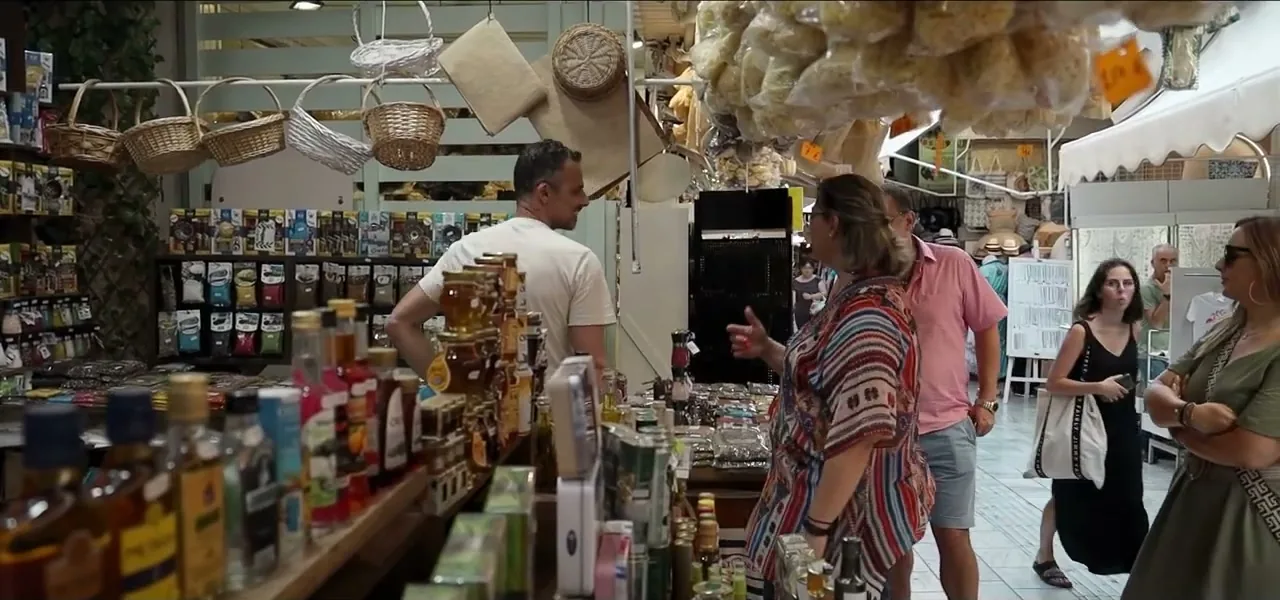
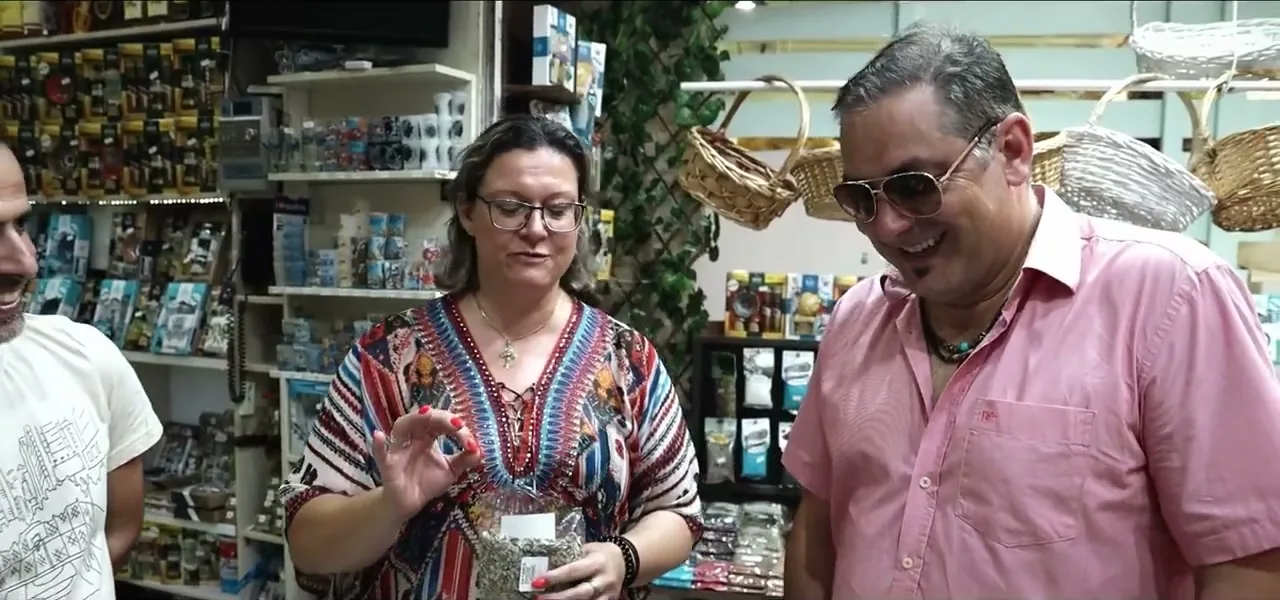
We started in Heraklion, the island's main city, and its traditional market — and Cretan hospitality hit me within minutes. A shop owner insisted on giving us samples and then pressed a parting gift on us as we left, simply because we were guests. He introduced me to dittany — diktamos, or erontas — an herb that grows only on Crete, prized since Minoan times as a healing tea and, the locals wink, an aphrodisiac. ("Let's get twenty of those," I said.)
Then came my introduction to the island's lifeblood: raki, also called tsikoudia — a strong, clear grape spirit distilled from what's left after winemaking, roughly Crete's answer to Italian grappa. We drank it as rakomelo, cut with Cretan honey, and my hosts insisted, straight-faced, that it's not alcohol at all but medicine. "Yamas!" — cheers — went around the table, over and over. It set the tone for everything that followed, because in Crete the drink, the food and the friendship are all the same thing.
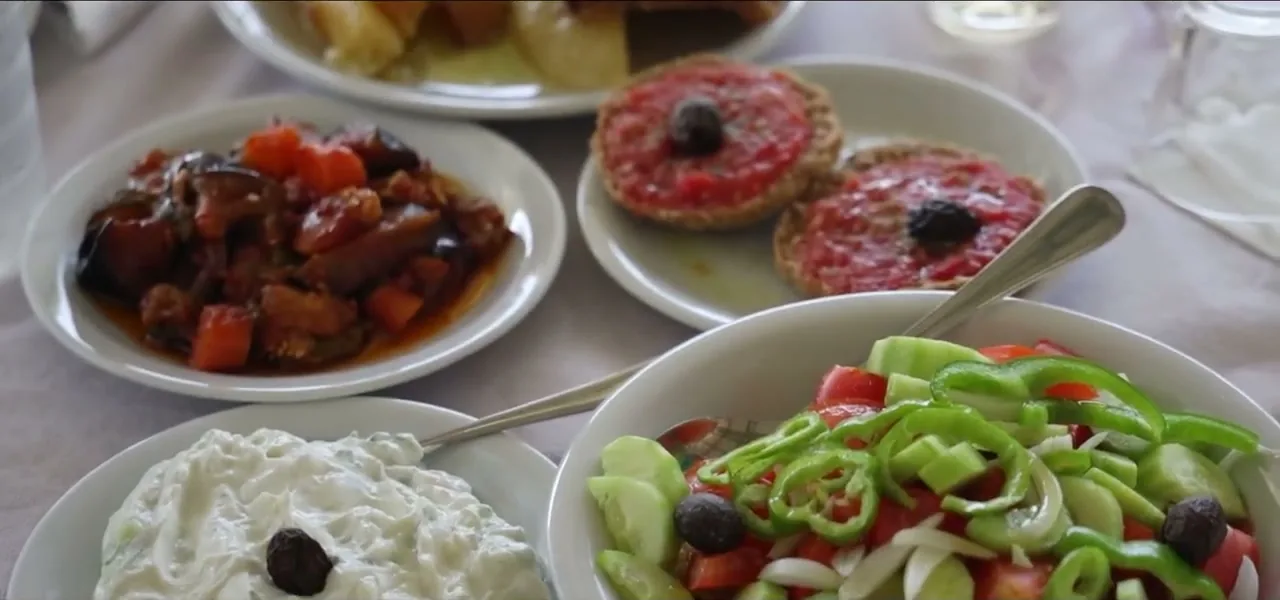
And the food. The Cretan diet is famous the world over as one of the healthiest on the planet, and eating my way through it I understood why: olive oil on everything, dakos (a barley rusk piled with grated tomato and soft cheese), tzatziki, Greek salad bright with real tomatoes, wild greens, and meat cooked slowly over wood and open flame. At a family lunch in Despina's home village of Asites, her cousins laid out a spread that could have fed the whole island. One thing to know before you visit: Greeks, and especially Cretans, eat late — dinner at 10 p.m. is normal, and the party only starts after that.
The Cretan Feast: 400 People Until Dawn
My very first night, Despina told me only that we were "going to see some friends." What she didn't mention was that those friends numbered four hundred people, all eating, drinking and dancing in the village of Avgeniki at an event called the Cretan Feast. This was no modern party with a DJ; it was hosted by some of the most famous traditional musicians on the island, and locals travel just to hear them play.
Here's where Crete's separateness really shows. Most people picture Greek music as the bouzouki and the famous "Zorba" dance from the old Anthony Quinn film. But Cretan music is its own thing entirely. The lead instrument is the lyra, a pear-shaped fiddle played upright on the knee, joined by the laouto (a lute that looks a little like a bouzouki but sounds nothing like it) and the mandolin. The melodies are faster, wilder, older.
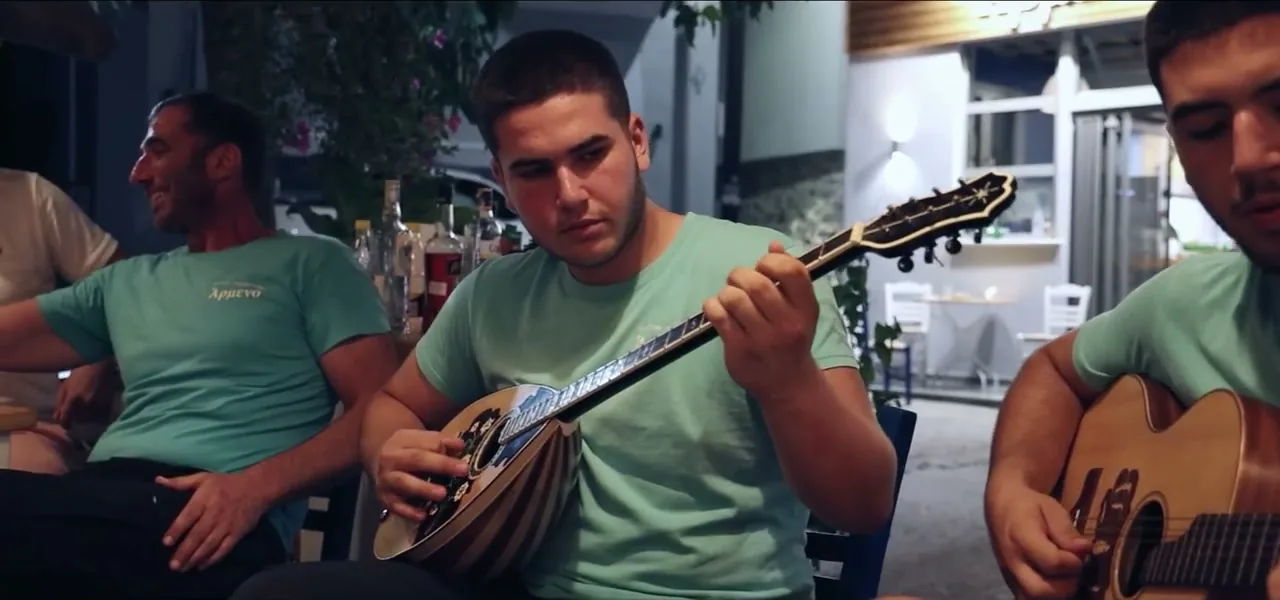
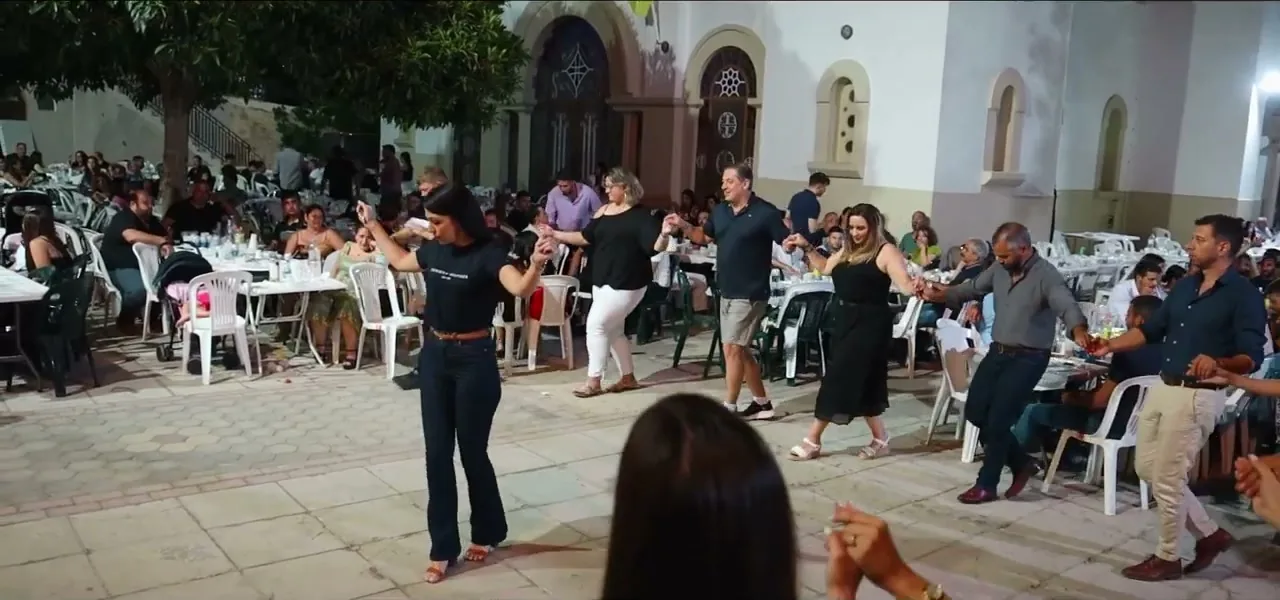
What moved me most was watching the people. Whole families, kids included — five, six, seven years old — dancing perfectly, having learned the steps almost before they could walk. At three in the morning, children were still on the floor, and nobody thought it strange; it's how the traditions get passed down. The dancing itself follows a beautiful ritual: someone requests a song, their friends form a circle, and the requester leads it — with others occasionally stepping in to lead a stretch and "show off" as a thank-you. The band plays on as long as the group has energy. Inevitably, my turn came. Despina had ordered a dance for me, and around 3 a.m. I found myself in the middle of the circle with what felt like two left feet — utterly clumsy, defeated by one impossible step, but grinning through all eight minutes of the song. Despina, kindly, said I did well for a first-timer. She was being generous. It didn't matter. I've rarely felt so completely inside a culture.
Milking a Goat and Living Like a Cretan
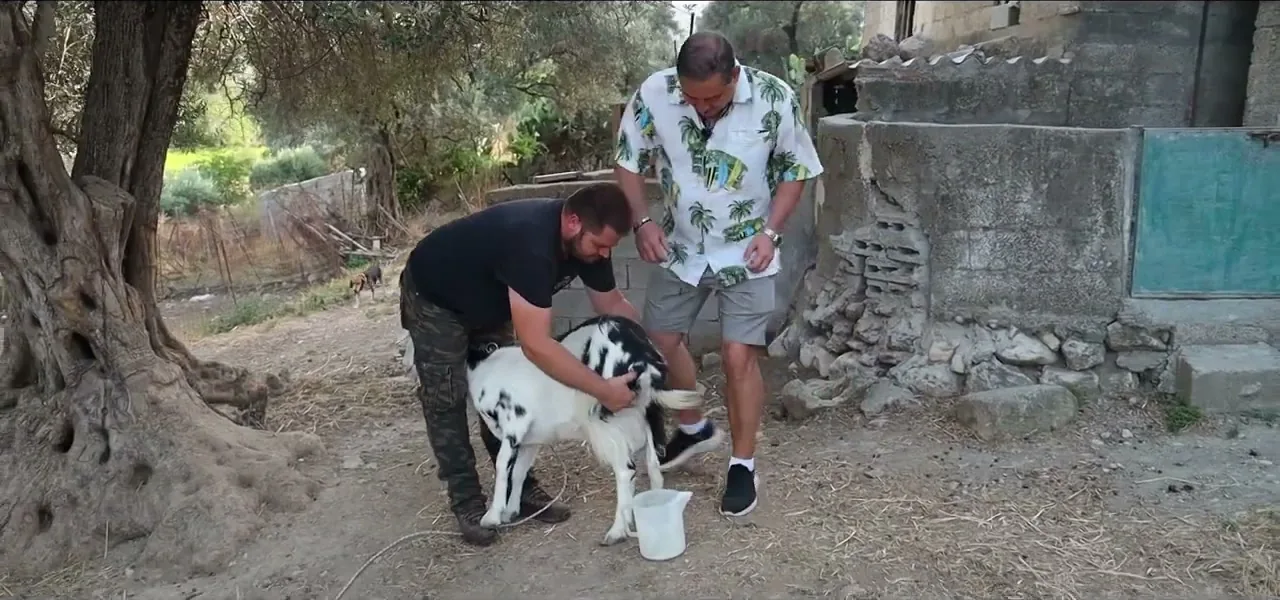
The next day, Despina promised another surprise. "Another 400 people?" I asked. "No," she laughed — "but maybe four-legged." She'd arranged for her friend Michalis to teach me to milk a goat. The moment we stepped out of the car, the whole flock started bleating as if they'd been expecting me.
Milking a goat, it turns out, is one of the strangest feelings you can have. Michalis made it look effortless — he worked the animal "like he was playing a video game," and since he spoke no English, all I could do was watch his hands. They looked so simple. But when I tried, pressing away with all my fingers "like I was playing piano," I could not produce a single drop, while everyone stood watching me fail. Eventually, finger by finger, the milk started to flow, and I felt an absurd, glowing sense of accomplishment. As Michalis put it, if you don't train your hands for all kinds of things, you're not going to get your milk. It's the sort of small, real, humbling experience I chase in every country — the opposite of a tourist photo op.
Are they really the "best Greeks"? I won't settle that argument — but I understand now why they make the claim with such a straight face.
Knossos and the First Civilization in Europe
Then Crete reminded me why its people are so proud. I went to Knossos, and if standing before the Acropolis in Athens made me feel like a visitor to history, Knossos made me feel like I'd stepped inside it. This was the great palace of the legendary King Minos, the largest ever found on the island, and the beating heart of the Minoan civilization — Europe's first advanced society, which flourished here in the Bronze Age more than three thousand years ago. It's often called Europe's oldest city, with a settlement on the site dating back an astonishing 9,000 years, to around 7000 BC.
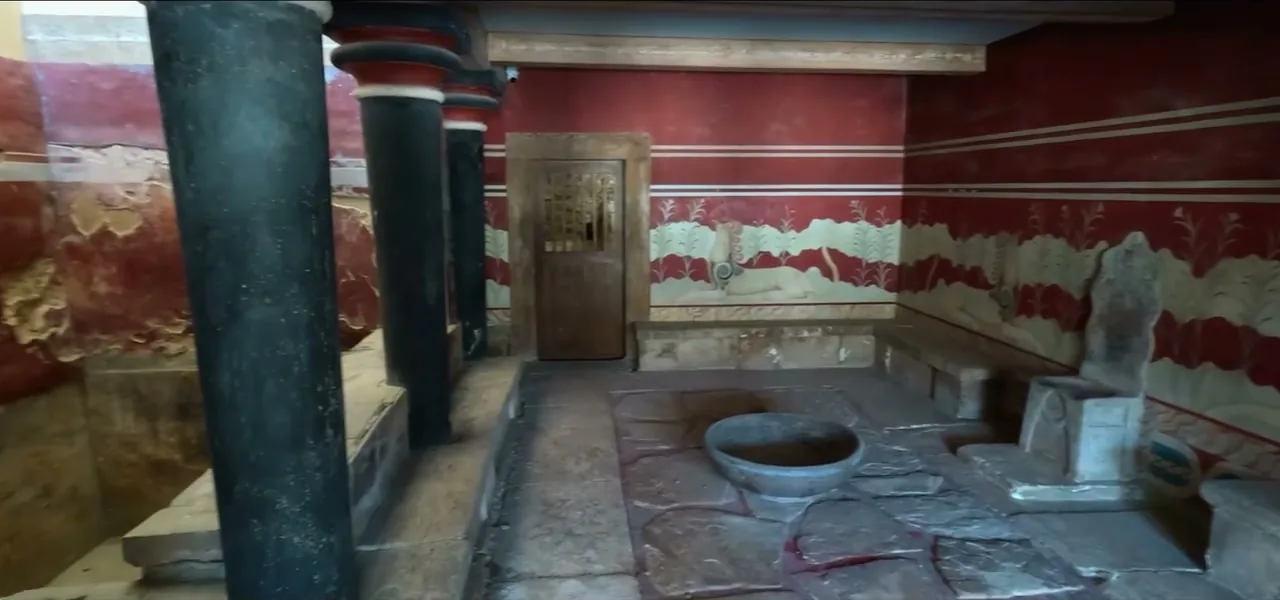
This is the palace that gave the world the myth of the Labyrinth and the Minotaur — the half-man, half-bull said to prowl a maze beneath these very halls — and whose red-columned ruins were famously excavated and restored in the early 1900s by the British archaeologist Arthur Evans. And the Minoans were no primitive people: they built multi-storey palaces with running water and drainage, traded across the Mediterranean, painted joyful, sophisticated frescoes, and wrote in scripts we're still trying fully to decode. To walk through Knossos — reading the signs, seeing the art, standing where a royal family lived nearly four thousand years ago — is to feel genuinely woven into something ancient. It predates the glory of Athens by more than a thousand years, and it happened here, on this island the rest of Greece sometimes forgets.
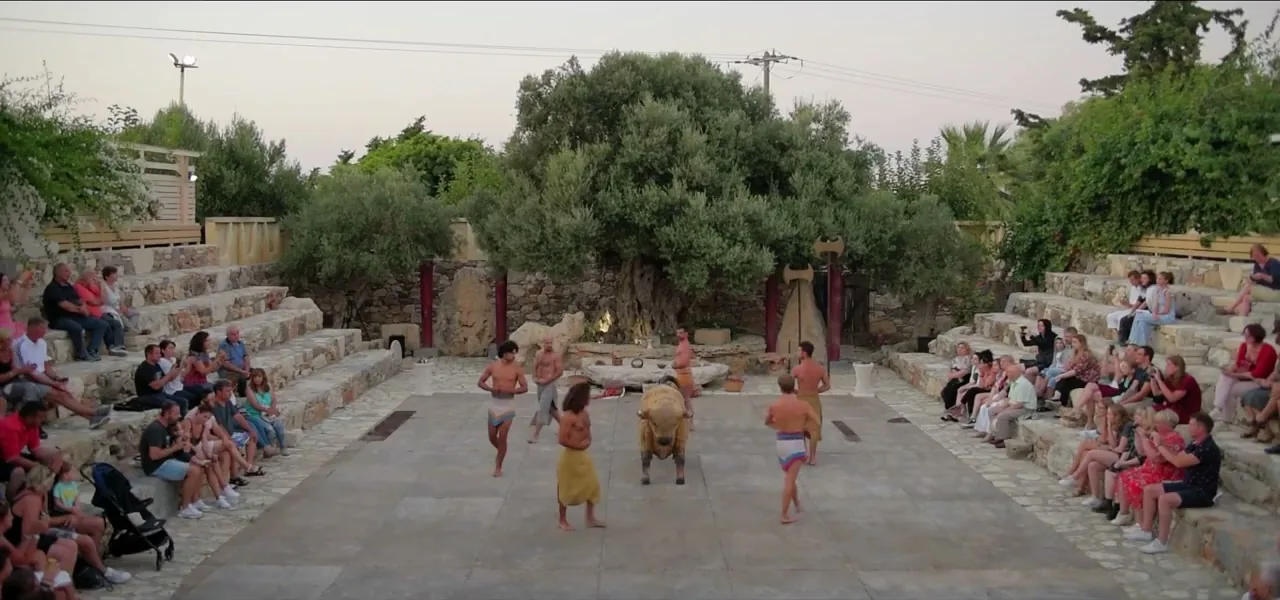
And Cretans don't just preserve this past behind ropes — some live it. I met Ana Bastaki, who built her own Minoan Theatre for one reason: to show the world the Minoans. There, she recreates Taurokathapsia — the extraordinary Minoan ritual in which young men and women would vault clean over a charging bull, immortalised in the famous bull-leaping fresco at Knossos. She's also spent decades hunting down the exact ingredients and recipes of actual Minoan meals, cooking them the ancient way. To eat a bread baked from a three-thousand-year-old recipe, in a theatre built to keep a lost people alive, is a very Cretan act of devotion.
A History Written by Conquerors
Stand at Knossos and you're at the start of the story, not the whole of it. After the Minoans faded, Crete's crossroads position made it a prize that changed hands for millennia. The Mycenaeans came, then the Dorians; then Rome, then Byzantium. The Venetians ruled for over four centuries and left the island's most beautiful towns — the harbours and fortresses of Heraklion, Chania and Rethymno still wear their Venetian faces today. Then came the Ottomans, and centuries of hard resistance, before Crete finally united with Greece in 1913.
Its most recent chapter is one Cretans wear with fierce pride: the Battle of Crete in May 1941, when Nazi Germany launched the largest airborne invasion the world had yet seen. What the Germans didn't expect was the islanders themselves — ordinary Cretan villagers, including old men and women, who took up whatever weapons they had and fought back so ferociously that it stunned the invaders. That spirit — proud, stubborn, unbreakable — is the same one you feel at the feast and the table today. Crete has been conquered many times, but never, its people will tell you, truly tamed.
Sunsets, Sea and the Meaning of Philoxenia
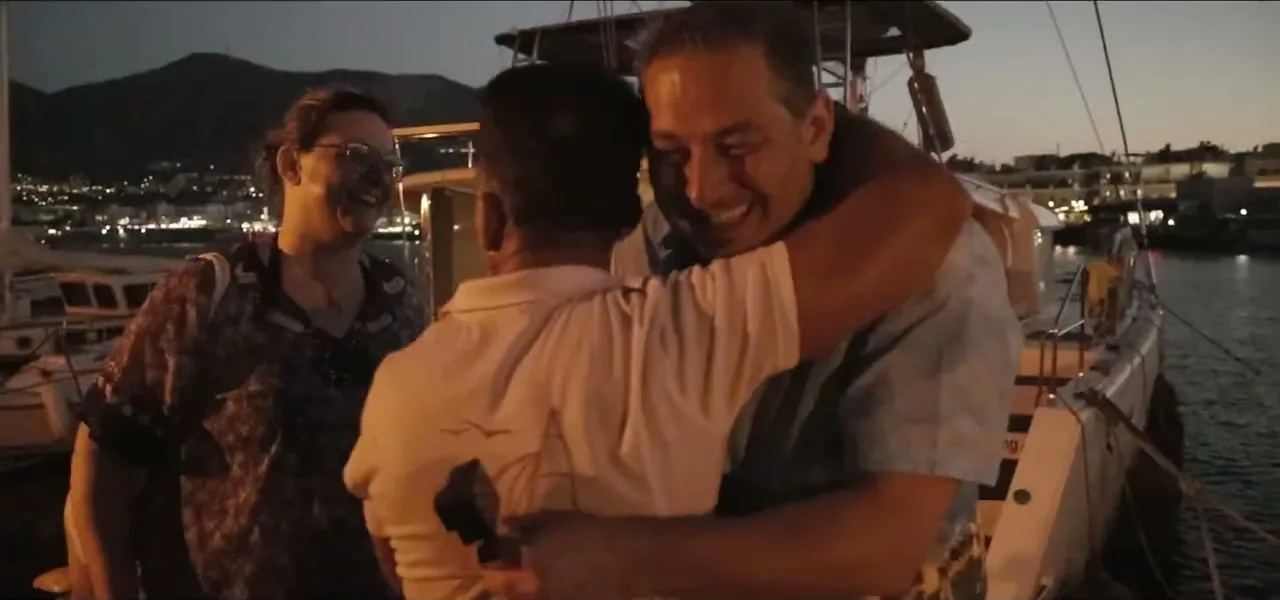
Crete isn't all history and hangovers, of course. Despina's team took me to Paralos Lifestyle Beach, one of the most popular spots in Greece — famous, apparently, as a place men fly in from all over the world to propose, right in a gazebo on the sand. (Not that I had any thoughts.) And I did what you must do here: a sunset catamaran cruise, aboard a boat cheekily named Sea Crete, with our charming host Cosmas. We swam, we jumped off the deck into the bay, and we watched a sunset so good — and I've seen sunsets all over the world — that it recharged me completely.
But the truest thing I experienced on Crete wasn't a view. It was philoxenia — literally "love of the stranger," the sacred Greek code of hospitality, which the Cretans take to another level. Some guys I'd met the night before at the Avgeniki feast — near-total strangers — said, simply, "Tomorrow night, we'll throw a party just for you." And they did. At the home of Panagiotis and his wife Eleftheria in Venerato, I arrived at 11 p.m. to a roaring fire with a whole lamb beside it: antikristo, big pieces of lamb staked around an open flame and slow-roasted for hours, an ancient Minoan cooking method still alive at village feasts.
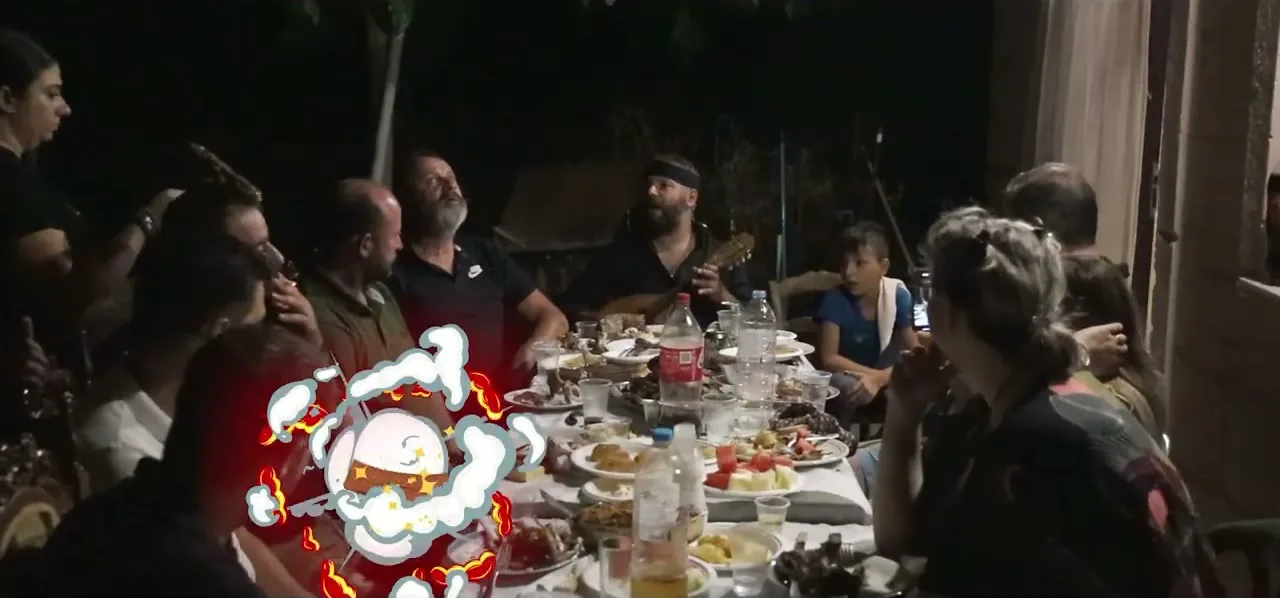
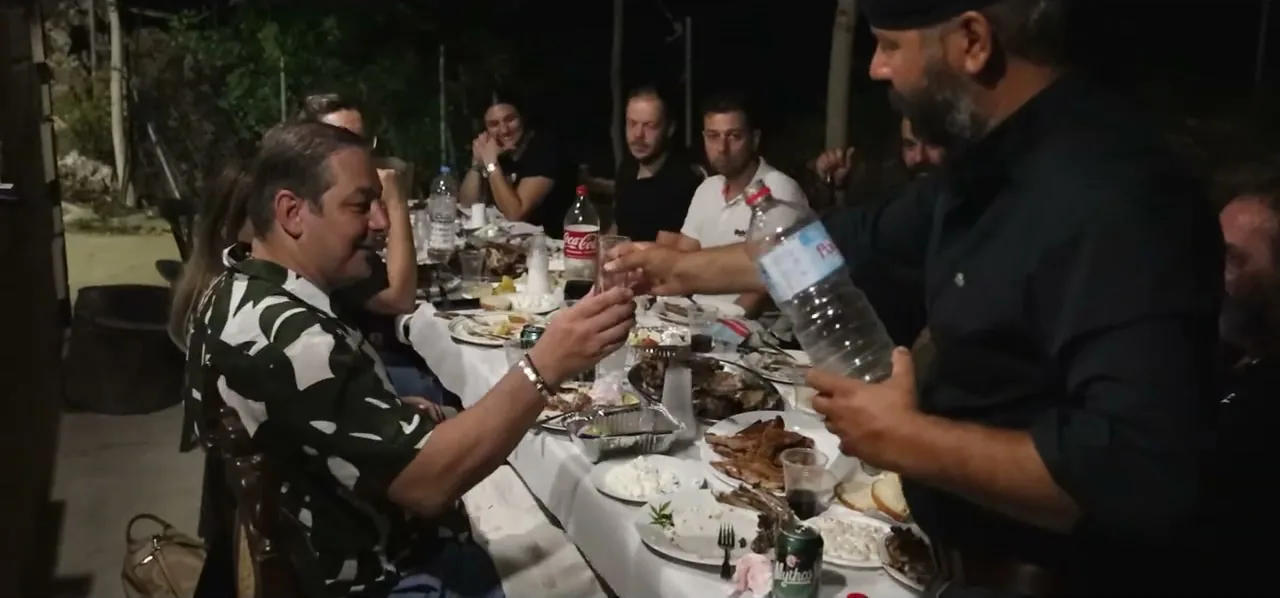
Then the drinking began, and it comes with a ritual that says everything about this place: everyone drinks from the same glass. One person pours a little wine, everyone takes a shot from that single glass, then the next person pours, and around it goes — a shared cup as a sign of the deepest hospitality. To a Cretan, having you at their table makes you the king; they'll offer whatever they have in the house, and it's considered the most sincere way to connect. Just when I thought we were done, the host picked up his mandolin again — and of course you can't leave while the host is playing — and the party rolled on until 3 or 4 in the morning. I do not regret staying up that late. If that's what life in Crete is, sign me up.
The Dart Throws to Africa
Every journey ends where the next begins, and for the dart ceremony I chose the most fitting spot imaginable: Ana's Minoan Theatre in Heraklion, on ground shaped by a civilization more than 5,000 years old, with a 1,700-year-old olive tree standing right behind my map. Blindfolded, I threw. The first dart missed the map entirely; the next hit Brazil — already done, two episodes' worth. So I threw again: Madagascar — been there too. One more throw, and finally a new one: Mali.
I'll be honest — Mali is a country I knew almost nothing about, and it isn't the sort of place the postcards sell. But that's exactly the point of Travel by Dart. "Mama Africa" is a continent I'm always keen to discover, and wherever the dart lands, I go looking for the beauty and the humanity that the headlines never show. So Mali it is.
By the numbers: Crete by the numbers
- Size
- Greece's largest island; 5th in the Med
- History
- ~5,000 years, from the Minoans on
- Knossos
- Europe's oldest city; settled ~7000 BC
- Endemic plants
- 100+ found nowhere else on Earth
- The feast
- 400 people, dancing until dawn
- That olive tree
- 1,700 years old
When to Go, and How to Do It
If Crete has you convinced — and it should — it's an easy island to reach and a rewarding one to plan for. Most people fly into Heraklion or Chania, or arrive by overnight ferry from Athens' port of Piraeus. Because the island is so large, a rental car is close to essential: the best villages, gorges and beaches are spread far apart, and half the joy is the drive between them.
As with the rest of Greece, timing is everything. Late spring (May–June) and early autumn (September–October) are ideal — warm seas, wildflowers or harvest, and none of the peak-summer crush. July and August are hot and busy, though the feasts and festivals are in full swing then. Broadly, western Crete (Chania, the gorges, Elafonisi and Balos) is the greener, more dramatic half, while the east and centre (Heraklion, Knossos, the wine villages) hold more of the ancient history. My one real piece of advice, though, has nothing to do with logistics: say yes. Say yes to the raki you're offered at 11 a.m., yes to the dance you'll be bad at, yes to the party thrown by people you just met. That's not a detour on a Crete trip — it is the Crete trip.
The Best Greeks
I arrived on Crete thinking it was one more Greek island and left understanding exactly why its people insist it's something more. This is a place where a five-thousand-year-old civilization isn't a museum exhibit but a living inheritance — in the music, the food, the dances, the fierce warmth of everyone you meet. Cretans freely speak their minds whether you ask or not; the landscapes are phenomenal; the food is simply delicious; and the hospitality is so total it borders on the overwhelming. I came as a stranger and was treated, over and over, like a returning son.
Are they really the "best Greeks"? I'm not going to be the one to settle that argument. But I understand now why they make the claim with such a straight face — and I meant it when I told them I might be back sooner than I planned. Crete was the perfect, soul-recharging end to a country that had already given me so much. If you're planning your own trip, don't stop at Greece's mainland and famous islands. Come all the way south, to the island that's a world of its own, throw yourself into a village feast, and let a Cretan pour you a glass from the cup he's already drinking from. You'll leave, as I did, a little in love — and quietly convinced they might just be right about being the best.
Explore More Travel by Dart Journeys
- Back to the mainland where this journey began: my Greece episode.
- More of the ancient Mediterranean the dart uncovered: Italy and Turkey.
- The balloon-and-rock dreamscape across the sea: Cappadocia.
- Another proud, food-loving corner of Europe: my home country, Romania.
Suggested Sources & Further Reading
To go deeper into Crete, these are some of the best authoritative resources:
- Visit Greece — the country's official tourism site.
- Encyclopædia Britannica — Crete — the island's geography and history.
- Encyclopædia Britannica — Knossos — the Minoan palace-city.
- Encyclopædia Britannica — Minoan civilization — Europe's first civilization.
All facts verified September 2026.
Greece: traveler questions
Where is Crete?+
Crete is the largest of the Greek islands and the fifth-largest in the Mediterranean, marking the southern edge of the Aegean Sea. Its main city is Heraklion. Sitting between Europe, Africa and the Middle East, it's large and varied enough to feel like a country of its own — and its people proudly consider themselves Cretans first, Greeks second.
What is Crete known for?+
Crete was the heart of the Minoan civilization — Europe's earliest advanced society — centred on the Palace of Knossos, often called Europe's oldest city. It's also famous for its music, its cuisine (one of the healthiest diets on Earth), its raki, and a fierce, generous hospitality the Cretans call philoxenia.
What was the Minoan civilization?+
The Minoans were Europe's first advanced civilization, flourishing on Crete during the Bronze Age (roughly 2600–1100 BC). Named after the legendary King Minos, they built grand palaces like Knossos — the source of the myth of the Labyrinth and the Minotaur — and left behind vivid art, including frescoes of the bull-leaping ritual known as Taurokathapsia.
What food and drink is Crete famous for?+
Crete is known for the Cretan diet, considered one of the world's healthiest: olive oil, dakos (rusk with tomato and cheese), tzatziki, wild greens, and antikristo — lamb roasted for hours on stakes around an open fire. The signature drink is raki (tsikoudia), a strong grape spirit, often mixed with honey into rakomelo. The endemic herb dittany is prized as a natural remedy.
Is Crete different from the rest of Greece?+
Cretans will happily tell you it is. The island has its own dialect, its own music (built on the lyra and laouto rather than the bouzouki), its own dances and its own traditions dating back thousands of years. As one local put it: 'Cretans first, then Greeks — but we are the best Greeks.'